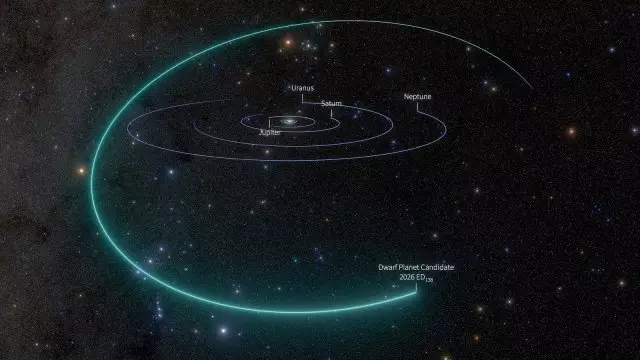
Some are clamoring to make it the Solar System's 6th official dwarf planet. They'll be shocked to learn how rich our own backyard truly is. This view of the Solar System shows the eight major planets of the system along with the newly discovered classical Trans-Neptunian object 2026 ED138, discovered with data from the Vera C.
The dwarf planet's position is shown on May 8, 2026. . Rubin Observatory/NOIRLab/SLAC/AURA/R. Zamani (NSF NOIRLab) Back in 2006, the International Astronomical Union controversiallydemoted Pluto.
This composite image of Pluto and its largest moon, Charon, was based on photographs taken by the New Horizons mission as it flew by the Plutonian planetary system back in 2015. Charon’s appearance is vastly different from Pluto’s, but both bodies are shown with the correct relative size and albedo. The surface features on Pluto show evidence of recent changes, indicating that the next time we visit Pluto to image it at this level of precision, it may exhibit a remarkably different appearance.
As part of that process, they officially defined “planet” and “dwarf planet” for the first time. The scientific line between planetary (above) and non-planetary (below) status, for three potential definitions of an orbit-clearing phenomenon and a star equal to the mass of our Sun. This definition could be extended to every exoplanetary system we can imagine to determine whether a candidate body meets the criteria, as we’ve defined them, for being classified as a true planet or not.
The four largest asteroids, all shown here, have been imaged with NASA’s Dawn mission and the ESO’s SPHERE instrument. Ceres, the largest asteroid, is the smallest known body definitively in hydrostatic equilibrium. Vesta and Pallas are not, but Hygeia, with a smaller mass but a much lower density, may yet be; its status is indeterminate.
Under a size cutoff of 10,000 kilometers, objects within our solar system appear to be round, pulled into hydrostatic equilibrium via their gravity and rotation, combined. However, once you go to planetary radii below ~800 kilometers, hydrostatic equilibrium, or even roundness, are no longer certainties, but composition dependent. There are over 100 objects in hydrostatic equilibrium in our solar system, including asteroids, moons, planets, dwarf planets, and Kuiper belt and Oort cloud objects, but only 5 official dwarf planets as of 2026.
Extract — continue reading at the source.