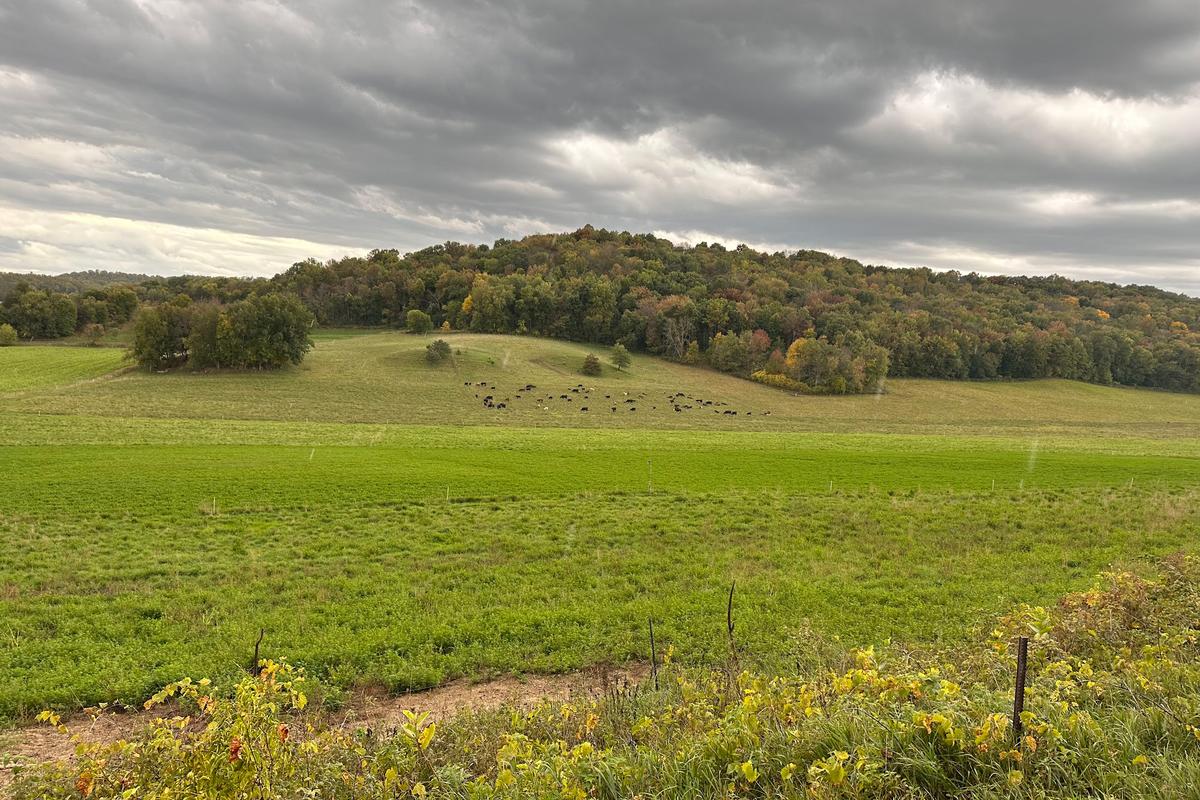
Managed grazing of beef cattle at the Gasser Farm in Witwen, in the southern Wisconsin Driftless Area, US. Photo by Randy Jackson Forty iron rectangles, each one blunt as a piano key, rotate into a blurring fury that hides the eight-foot-long shaft at the heart of the flail chopper. I am perched atop several tons of iron, with 80 horsepower at my command.
This part of farming is straightforward – even a mechanically challenged tree-hugger like me can manage to depress the clutch, shift into second, and ease the throttle forward. The tractor’s tall, deeply treaded tires churn, revolving into a smooth spin. Everything is spinning: fans, belts, alternator, the driveshaft, axles.
I don’t understand the mechanism fully, yet the tractor and chopper and I are propelled forward across the knee-high whiskers of a coarsely bearded cornfield. It is Indian summer in southern Wisconsin. My wife and I and our young son live here on her family’s farm.
Both of us are employed off the farm, but on weekends and many evenings I am an apprentice to my father-in-law, David. Today, we are taking advantage of a brief period of warm, dry weather. Winter is approaching, and I could be spending the day beside our woodsplitter – the gasoline-sipping, hydraulically heroic mechanism that makes it possible to put up several cords of firewood quickly each year – but that work can wait until the cool, sunny days of fall are shoved aside by the relentless spin of the earth into darkness, sleet, snow and frozen ground.
The wall of tall green corn that stood here this summer has been transformed by fall and harvest. Little is standing after the field was stripped by a seed-combing combine. The mechanical tornado flails so loudly behind me: wailing against the air, grinding off the root-buttressed corn-stalk stumps, sucking up spent leaves and stripped cobs.
In my wake, dry corn litter passes through the chopper like water compelled into frothy turbulence, falling again into an even, silent surface that hides so much activity below. No time to waste – the weather is expected to hold for another day, and I need to cover the field before the light fails this afternoon. Tomorrow, David will rake this chewed-up detritus into windrows and then come back for another round to bale them up.
Extract — continue reading at the source.