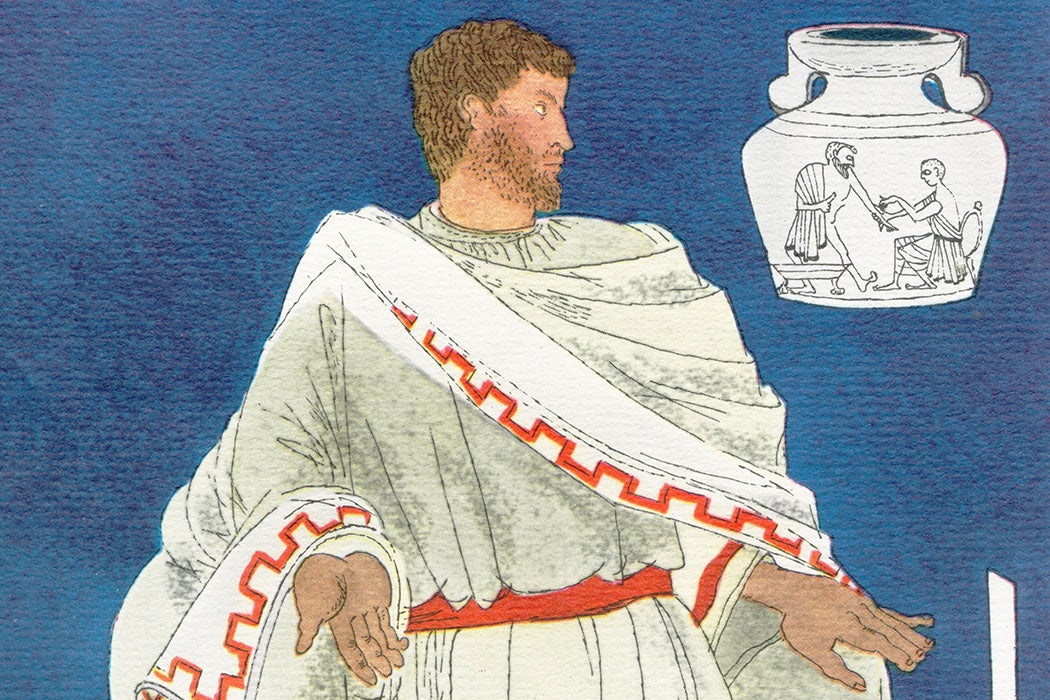
Ancient Greek and Roman doctors recommended medications that we would regard today as gross and disgusting. Harris lists “animal and human excrement, also urine, blood (menstrual or not), brains, spit, sweat, earwax.” Not to mention “crushed beetles, centipedes cooked in oil (for earache), and castoreum” (supposedly secretions from beaver testicles), “although what was sold as such was certainly nothing of the kind.” Harris is most concerned with the classical era up to around 400 CE, but notes that the Greeks, who influenced the Romans, were themselves influenced by the earlier Babylonians and the Egyptians in such prescriptions. He also writes that popular or folk medicine—which “may well be thought of as the origin of the physicians’ recommendations”—continued to call upon such medications into the eighteenth century.
Not that the practice suddenly stopped with the rise of “rationalistic medicine.” There are twentieth-century examples of such folk remedies, including “in the Veneto a hundred years ago the warm excrement of an ox was considered an effective remedy for dolori articolari” or joint pain. While the ancients—and people living on farms after them—may well have had different tolerances for disgust, Harris suggests that disgust may actually have been part of the appeal of such Dreckapotheke, or “dirt medicine.” “It was precisely because such disgusting substances were shocking (in varying degrees) to their patients that physicians made use of them,” writes Harris. Perhaps realizing that they could offer “no more than the merest palliatives,” these early physicians offered up shock value instead.
Sometimes at least, ancient physicians liked to have a dramatic effect on the patient’s body [as the centuries of purgatives attest]; an assault on his or her sensibilities might be almost as useful.” Desperate straits, desperate measures—or, this is so gross it has to work. The evidence is scattered and obviously incomplete, but surviving writings show that some physicians “made a modest amount of space for the use of excrement and urine” while others “seem to have employed such substances extensively.” Still others rejected the use of such substances “entirely or almost entirely.” Some recommended only animal excrement. The Hippocratics, followers of Hippocrates, favored bolbiton, or cow dung (which somehow did not make it into the Hippocratic Oath).
Pliny’s famed Natural History “proclaims the medical value of excrement,” particularly that of pigs, goats, and cows. Others “sometimes countenanced the use of human excrement too.” Galen said he would not apply goat dung to one of his rich Roman clients, but thought it was suitable for a peasant, whom he considered akin to a donkey anyway. He also applied human urine to other peasants and to enslaved people.
A fourth-century list, which may or may not have been written by an actual doctor, contains twenty-two bird poop recipes, about half of them for skin conditions. Underlying these treatments was the belief that special strengths or forces were attributed to gross things. It was, in a way, magical thinking.
It was precisely the (attributed) power of excrement—as illustrated, for instance, by Galen’s recommendation of dog excrement for what seems to have been a severe form of sore throat or acid reflux—that was the point.
Extract — continue reading at the source.