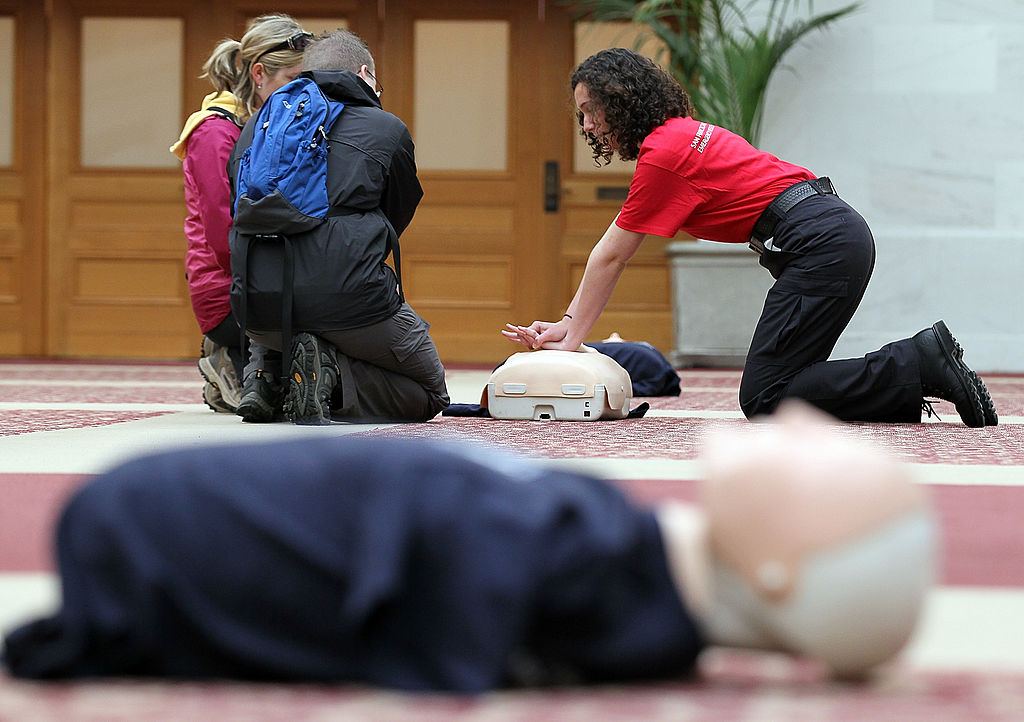
In 2024, two Michigan high school students were sitting in the bleachers during a student-teacher basketball game when their physical education teacher collapsed from cardiac arrest. They had both recently learned cardiopulmonary resuscitation (CPR) at a career-focused technical nursing center and rushed to help, beginning chest compressions and using an automated external defibrillator (AED) before emergency responders arrived. We often describe the difference between life and death as a matter of speed: how quickly emergency services arrive and how fast a hospital can intervene.
But in reality, cardiac arrest outcomes often depend on whether someone nearby begins CPR in the first few minutes, which rarely belong to emergency responders, but instead to whomever is standing closest: a classmate, teacher, stranger at a basketball game, or someone waiting for a train. Every minute without CPR sharply reduces81302-2/abstract) the chances the patient will live long enough to reach a hospital. Schools occupy a special role in public health.
As a location most Americans pass through and one of the only places they may ever encounter CPR training, a high school classroom may be the best opportunity to prepare the next generation of lifesavers. Schools already rehearse fire drills and lockdown drills for dangers that are statistically rare. Cardiac arrest is the reverse: far more common, and far less rehearsed.
CPR skills can save lives years down the road when a cardiac arrest occurs at home, in a gym, at an airport, or at a university. Harnessing that opportunity requires both the resources to teach CPR effectively and the policies to ensure every student has the chance to learn it. In Europe, Belgium, Denmark, France, Italy, Norway, Portugal, and England implemented school CPR education30723-8/fulltext) through national requirements or curriculum standards.
Denmark offers a clear example of the positive impact. From 2001 to 2010, as Denmark introduced nationwide resuscitation initiatives including mandatory school CPR education, bystander CPR rates more than doubled, while 30-day survival after out-of-hospital cardiac arrest more than tripled. A central challenge is how to implement CPR training at scale.
The international KIDS SAVE LIVES initiative offers a practical blueprint. Endorsed by the World Health Organization, it calls for recurring, age-appropriate basic life support education beginning in childhood. Research from the International Liaison Committee on Resuscitation shows children can learn the early links in the chain of survival from the young age of 4, perform effective chest compressions by age 12, and pass skills to family members and others.
Extract — continue reading at the source.