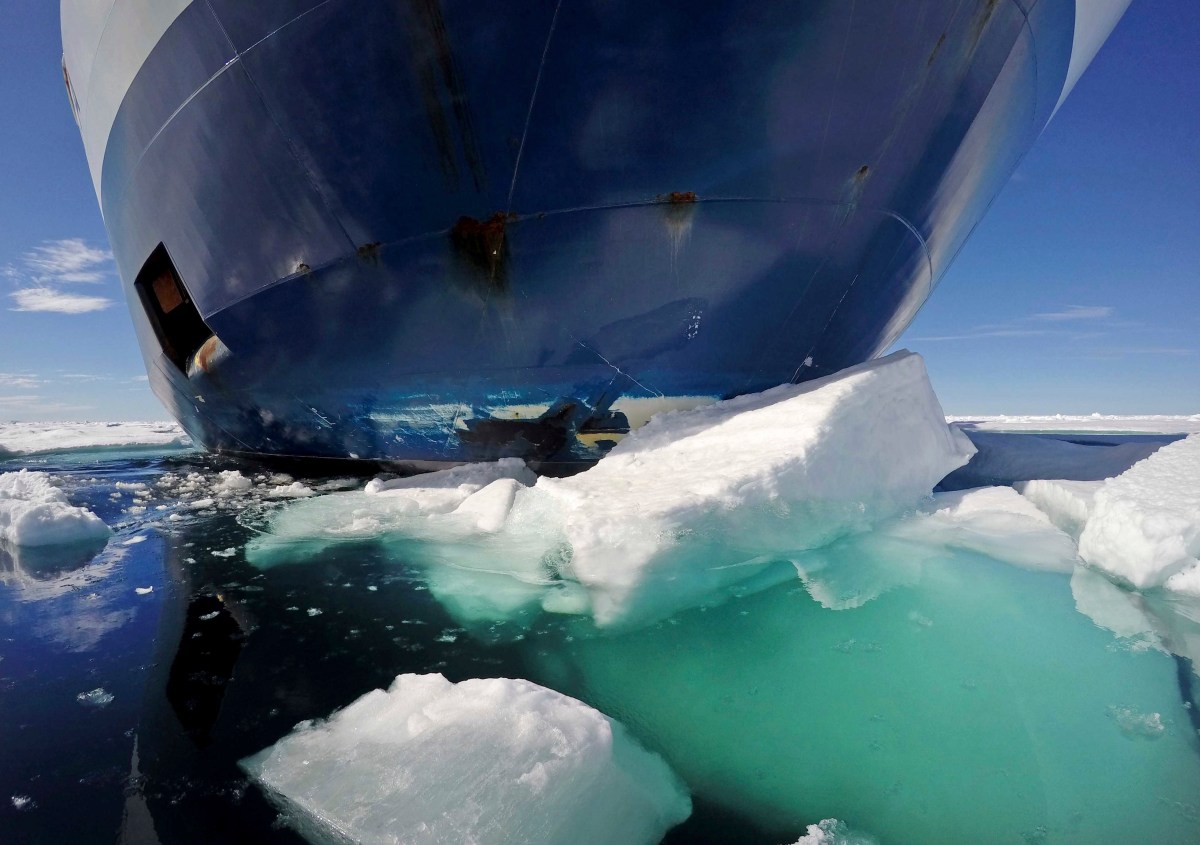
Turns out that when it comes to building icebreakers, the Arctic nation and superpower U.S. needs quite a lot of help from its friends. Not enough, or not the right, technologies and skilled industrial workers—seven years after the U.S. government commissioned the first heavy icebreakers in half-a-century from an American shipyard, not a single one is ready and the first of the three planned may not be until 2033 at the earliest, according to a scathing report by the Government Accountability Office (GAO). It’s a similar picture in Canada, where, on Monday, the government announced a new program worth $11 billion to build six icebreakers for the Canadian Coast Guard.
Prime Minister Mark Carney said the first ship would be ready by 2032 and the entire fleet by 2038. America’s atrophy comes even as the Arctic becomes steadily more important, and contested, for reasons as diverse as climate and research, security and economics, and new technologies. Counterintuitively, perhaps, things are a lot sunnier in northerly Finland than in the American South where traditional, major shipbuilders are located on the Gulf Coast.
Work began this year on the first of four Finnish-built new icebreakers for the U.S. that are expected to be ready fast—by the end of 2028. "Finland traditionally has been a kind of superpower when it comes to building icebreakers," Robin Häggblom, a senior adviser at the Denmark-based company Risk Intelligence, told Newsweek. About 60 percent of ice ships in the world were either built in Finland or according to Finnish designs.
That skill is born of necessity since all of Finland’s ports regularly freeze over every winter. So the U.S. finds itself in a humbling position: to maintain and expand its presence in the Arctic, it must learn from a small, European ally. Finland joined NATO in 2023 in the aftermath of neighbor Russia’s full-scale invasion of Ukraine.
"For these kinds of polar Arctic capable icebreakers, there really isn't a know-how in the U.S., because, if you build a vessel every 50 years, you just can't keep the base of knowledgeable people both in the research development side but also in the workforce," said Häggblom, who also blogs as Corporal Frisk. When the White House announced a deal last year to build up to 11 Arctic Security Cutters for the U.S. Coast Guard, the Finns were an integral part of the picture.
The contracts are worth $6.8 billion and, in the main, involve two U.S. companies: Bollinger Shipyards, working with Finland’s Rauma Marine Constructions; and Davie Defense, with the Helsinki Shipyard. After the first ships are built in Finland, the technology and skills will be transferred to the U.S., the demandeur or weaker partner, the learner in this arrangement. The need for the cutters is urgent.
Extract — continue reading at the source.