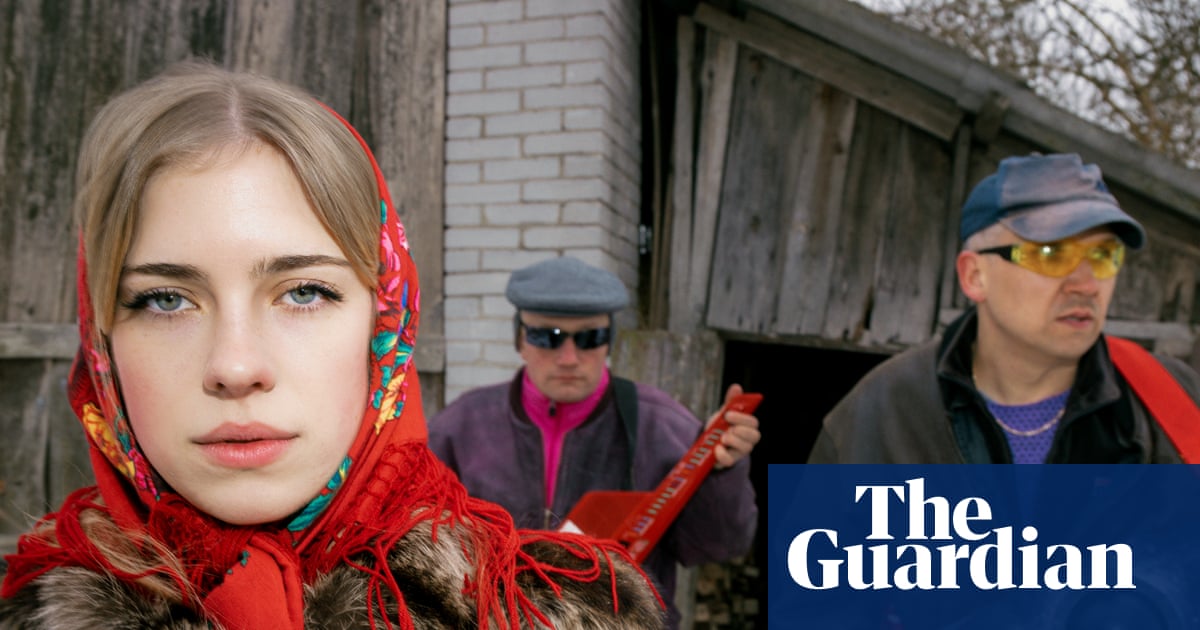
It’s 6pm on the first day of OFF festival in Katowice, and a crowd is gathering in front of one of the stages to watch newcomers Tercet Imperial. Sporting disco outfits of nylon jackets, tracksuits and Chicago Bulls caps, keyboardist Piotr Zabrodzki deploys resonant acid melodies, while drummer Jan Emil Młynarski plays a rapid, irregular rhythm that brings to mind the scattergun beats of footwork, the ghetto-house subgenre that grew out of Chicago in the late 90s. Not many of those jerking their limbs to the music in front of the stage are likely to realise that they are listening to a distinctly Polish sound: that of the oberek, a traditional dance in triple meter whose name derives from the Polish verb “to spin”, because it usually accompanies couples whirling across dancefloors in a circular motion.
On Tercet Imperial’s debut album, Prymat, the melodies and lyrics of traditional songs are woven into contemporary production: violins and a snare drum are replaced by synthesisers and drum pads. Footberk Suite, by drummer Gary Gwadera (real name: Piotr Gwadera), is a concept album about an imagined meeting of the oberek and Chicago footwork. Its genesis can be found in the influential footwork compilation Bangs & Works Vol 1, released by Planet Mu in 2010, which was an inspiration to Gwadera.
To record it, he used dżaz, a minimalist percussion kit from the Polish countryside, along with a Roland TR-808 and electronic pads. Musician Mateusz Kowalski offers a different take on this traditional music with his groups Radical Polish Ansambl, Tęgie Chłopy and Warszawska Orkiestra Sentymentalna. On his first solo album, released last year under the name Sam Kowalski, he replaced the violin with a gitalele (a small instrument combining the features of a classical guitar and a ukulele) and slowed the tempo, with no percussion – transforming the oberek’s nervous phrasing into a gentle, melancholic flow reminiscent of Appalachian folk music.
Elsewhere, Polish duo Opla first translated the tripartite rhythms and raw energy of the oberek to electric guitar and drums, and later to electronic pads, adding effects and looped guitar parts. Polish-French jazz quartet Lumpeks sound like Ornette Coleman on a prolonged ramble through the Polish countryside. Suferi, meanwhile, combines oberek rhythms with electrified violin, an effects-laden guitar, and a hip-hop groove on the drums.
Often, even a seasoned ear won’t immediately pick up on the traditional dance’s influences – and that’s precisely the point. As Kowalski explains, when releasing the self-titled album, he didn’t describe it as traditional music. The idea is for people to be surprised when they find out that this is traditional material,” he says.
The new interest in Polish tradition and its creative expressions stems from the turbulent history of rural music in Poland. Before the second world war, it was part of everyday life – weddings, celebrations and rituals – and passed down by ear. But war and migration disrupted the continuity of music across regions.
Extract — continue reading at the source.