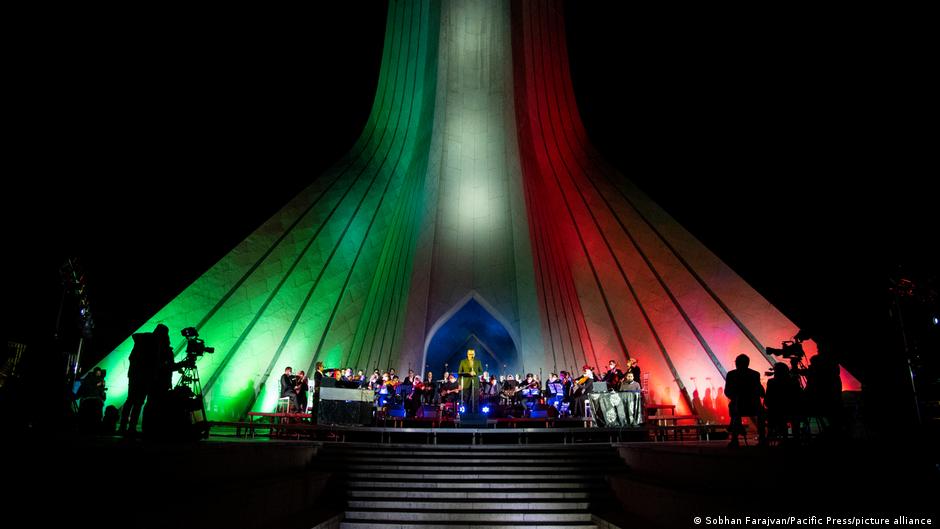
After spending 47 years abroad, Iranian musician Bijan Mortazavi returned to his homeland at the end of September. Mortazavi is one of Iran's most renowned violinists, singers, and composers. In July 2026, he performed with his famous white violin at the closing ceremony of the FIFA World Cup alongside the New York Philharmonic Orchestra.
In the videos that he and his wife have now posted on social media, the couple can be seen taking walks through the city of the Iranian capital, Tehran, while passersby greet the musician warmly and welcome him. Singer Mohsen Namjoo also recently returned to Iran after about 20 years in exile. Internationally renowned for his experimental Persian music, he blends traditional Persian singing and poetic lyrics with elements of blues, rock, jazz, and folk.
In 2009, Namjoo was sentenced in absentia by a court in Tehran to five years in prison. He was accused of insulting holy sites and mocking verses from the Quran, among other things. In a video posted online after his return to Iran, Namjoo said he had returned to the country to spend more time with his family and friends.
On August 27, Abbas Salehi, Iran's minister of culture and Islamic guidance, said in an interview with the prominent Iranian media outlet Farhikhtegan that his ministry had compiled a list containing the names of more than 100 distinguished Iranians living abroad. The goal, he said, was to remove obstacles to their travel or return to Iran. Salehi stressed that even "critics of the Islamic Republic" could return at any time.
He added, however, that the return of artists does not necessarily mean they would perform in Iran. Instead, they could simply visit the country, the minister said. Sina Yousefi, a human rights lawyer, pointed to international law, specifically Article 12 of the International Covenant on Civil and Political Rights, to which Iran is also a signatory.
According to this provision, no one may be arbitrarily prevented from entering their own country. This right cannot be made contingent on a citizen's level of loyalty to the government, he told DW. "The idea of seeking out certain well-known figures — who the reformists, in particular, believe are less likely to cross the red lines — and winning them over to collaborate or bringing them back to the country is not new," said Sepideh Raissadat , an ethnomusicologist who has been studying the history and development of Persian music for years.
Extract — continue reading at the source.