Once the undisputed giant of Nigerian politics, the Peoples Democratic Party now finds itself on the brink of extinction. A question hanging over the campaign for January's general election, which officially kicked off this week, is whether the PDP can survive. A factional struggle that has ended up in the courts over who exactly is in charge could end up rendering it irrelevant at the ballot box.
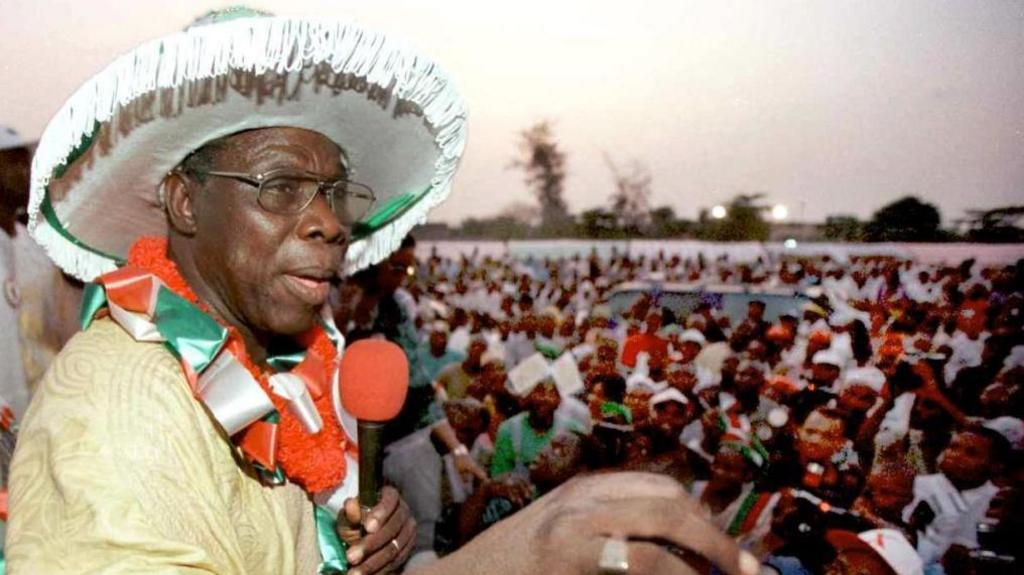
It is a remarkable fall for the party, founded in 1998, which appeared impregnable after the end of military rule a year later - so much so that its chairman boasted in 2008 that it would govern for six decades. For 16 years, it controlled the presidency - in the shape of Olusegun Obasanjo, Umaru Musa Yar'Adua and then Goodluck Jonathan - and the vast majority of the country's 36 states. But the 2015 federal election was a seismic shock.
The PDP lost the presidential vote to Muhammadu Buhari and the newly formed All Progressives Congress (APC) - a coalition of opposition parties and disgruntled former members. Thrust into the political wilderness the party's national leaders were bewildered - familiar with the trappings of federal power they had to work out what to do in opposition. This was the beginning of the end, according to political analyst Ishaq Buhari.
"They were a party that was so used to power, being in opposition was a new challenge they struggled with from the start," he told the BBC. If 2015 was a major blow, 2025 was the year the party's foundations were left in ruins. It was marked by a dizzying wave of defections and bitter internal conflicts.
A group of state governors switched party allegiance, which had a particularly devastating effect. At the start of that year, the PDP still held eight states. But by December, five state governors - from Delta, Akwa Ibom, Enugu, Bayelsa and Rivers - had gone over to the ruling APC.
They cited the PDP's declining viability and a desire for better co-operation with the federal government as reasons for their departure. Early this year, the PDP held three states but that is now down to zero - with the Oyo governorship slipping from the party's hands just last month. Internal power struggles, factionalism, insistence that power rotates through the regions and disciplinary measures have all added to the sense of disillusionment within the party.
Extract — continue reading at the source.