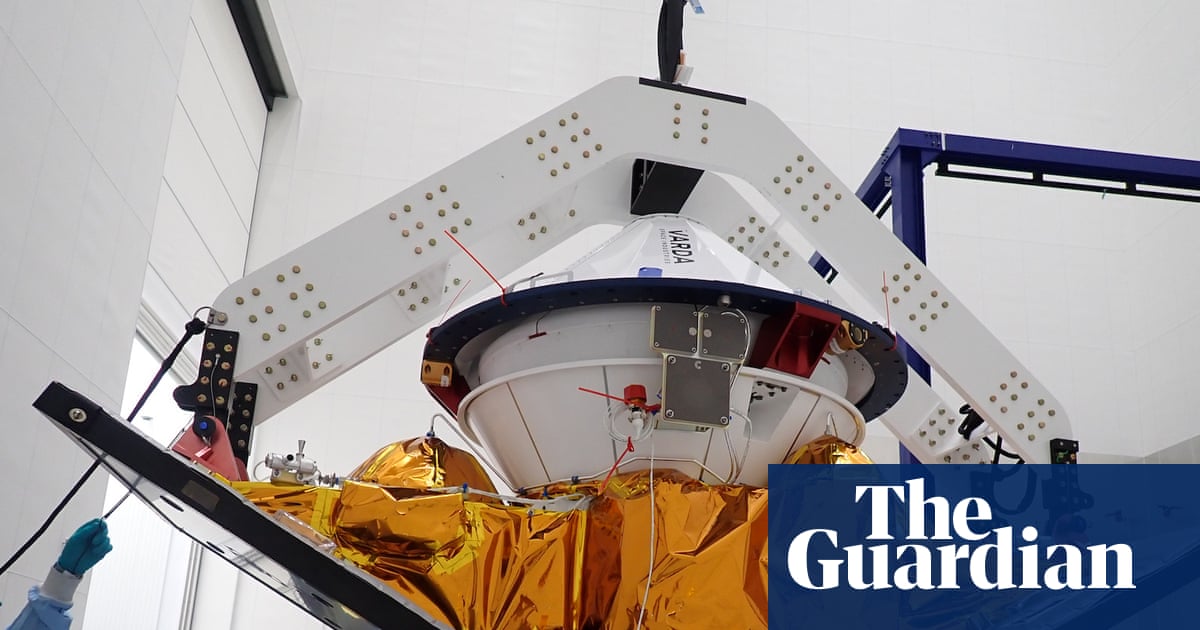
Roughly 300 miles above our heads, three washing machine-sized capsules are orbiting the Earth. Inside one of them, tiny crystals of a potential cancer drug are being grown in the weightlessness of space. The others are testing heat protection materials and navigation systems for when the capsules plunge back through Earth’s atmosphere at hypersonic speeds.
Together, they represent a small but significant step towards what some hope will become a lucrative new industry: manufacturing drugs and other materials in space. The spacecraft belong to California-based Varda Space Industries. On 1 October, it launched two onboard the same rocket, followed by the third on 20 October.
With a record three spacecraft now simultaneously in orbit for the first time, the company is edging closer to its ambition of operating a fleet of orbiting pharmaceutical factories. There are several reasons for wanting to manufacture certain materials in space, one of the most important being microgravity. On Earth, gravity causes particles suspended in liquids to settle, while differences in density create currents.
Both can interfere with the growth of crystals. For pharmaceutical companies, this could open up new ways of formulating medicines, as the size, shape and arrangement of drug crystals can affect how easily drugs dissolve, how stable they are and how they can be administered. In some cases, this could enable drugs that currently require intravenous infusions to be reformulated into more convenient injections.
Other materials, such as the semiconductors used in everything from smartphones to electric vehicles, could also benefit from being manufactured in space, where microgravity and the absence of air could help produce purer crystals with fewer defects. It’s a similar story for semiconductors. If you can reduce the number of defects, you can get a much higher-performing material.” Scientists have been experimenting with manufacturing in microgravity for decades, particularly aboard the International Space Station (ISS).
But the ISS has predominantly served as a “test kitchen” for scientific ideas and is scheduled to be retired around 2030. Several companies are developing commercial space stations to replace the ISS, while others are designing specialist laboratories and equipment for conducting experiments aboard them. Among them is the UK-based BioOrbit, which recently sent a microwave-sized laboratory to the ISS as a step towards the production of self-injected cancer drugs.
Extract — continue reading at the source.