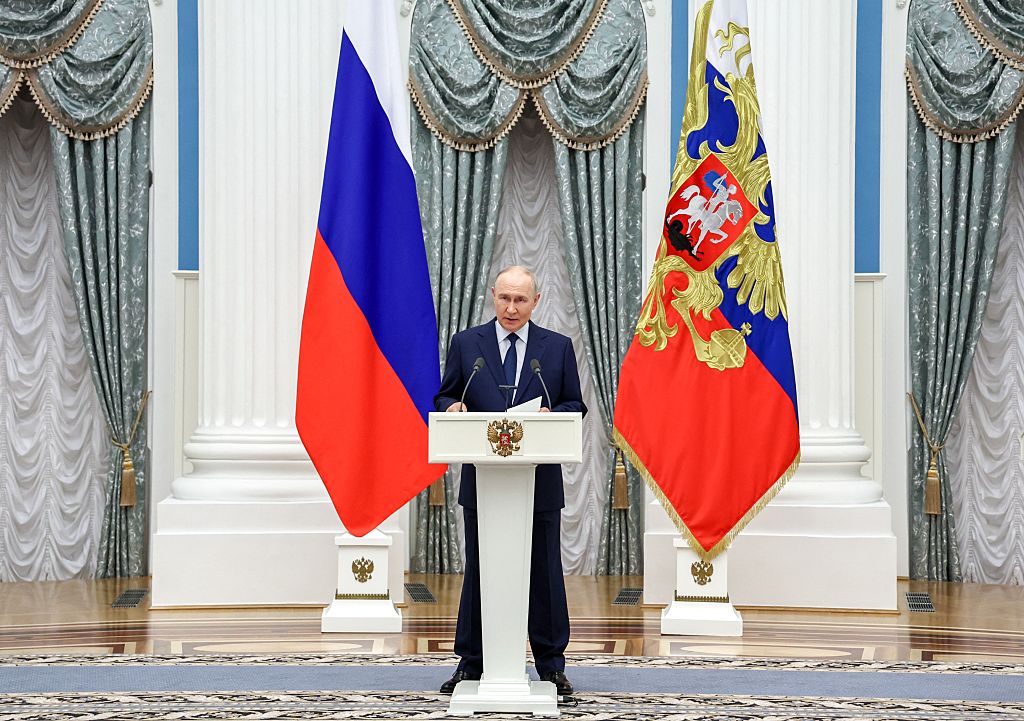
Russia is just one day into three-day elections that will determine the makeup of the lower house of the country’s parliament, the State Duma. But the outcome of the vote has been all but guaranteed since before the first ballots were cast. The elections, the first parliamentary vote the country has held since its invasion of Ukraine in 2022, are widely expected to result in the Kremlin-aligned United Russia party maintaining its overwhelming dominance in the Duma.
The party currently holds 310 of the 450 seats in the chamber, giving it a supermajority and the power to make major legislative decisions without the input of other parties. It needs to keep at least 300 seats to retain that supermajority. Four other political parties are also expected to be represented in the Duma following the election, all of which generally vote in line with United Russia and support the war in Ukraine.
They are the Communist Party of the Russian Federation, the Liberal Democratic Party of Russia, the A Just Russia party, and the New People party. Democracy watchdogs and foreign governments have denounced Russia’s elections as being neither free nor fair. Russian officials have rejected such claims in the past, saying that the country carries out its voting process in line with the law.
But experts tell TIME that the Russian government exerts its influence in ways that all but predetermine the results of elections and ensure that President Vladimir Putin and United Russia maintain control. And this year’s vote, says David Szakonyi, an expert on Russia and election fraud who is professor at George Washington University, is “occurring in the most repressive political environment in Russia's post-Soviet history.” Here's what experts have to say about how the Kremlin ensures elections result in its desired outcome—and why it continues to hold them. The Kremlin uses multiple levers to influence elections on the government level, at the polls, and in daily civilian life, according to Szakonyi.
In the case of the ongoing parliamentary vote, the one anti-war party that was registered by the Central Election Commission, the Yabloko party, was prohibited from participating in the election by Russia’s Supreme Court. The high court ordered that the party be removed from the ballot last month in response to a lawsuit from the pro-Kremlin Rodina party that accused the Yabloko party, which has garnered support from young Russians and those opposed to the war in Ukraine, of copyright infringement, receiving foreign funding, and extremism. Szakoni says that the Kremlin has the ability to “harness the judicial system to pass rulings” such as the Supreme Court’s decision against the Yabloko party, which it uses as a “legal veneer” that shields the influence of Putin’s government over the ballot.
This screening of anti-war and other opposition parties, he says, comes months in advance of elections, creating a list of candidates that includes little or no meaningful opposition at all. The Kremlin has also labeled opposition figures who oppose the war as “foreign agents,” a designation that prevents them from holding public office. In other instances, opposition leaders and activists such as Alexei Navalny have been prosecuted and imprisoned.
Extract — continue reading at the source.