The word disruptor is a vividly descriptive one, and it’s almost always applied to an individual. But it doesn’t have to be. Take the rule-busting, category-smashing, one-of-a-kind-because-you’ve-never-seen-anything-of-its-kind “You Can See Everything,” a movie that in one weekend has turned the movie landscape topsy-turvy.
It’s a documentary…made by a prankish cringe comedian…about a notorious white-collar criminal…that plays as a piece of hangout-movie vérité…until the actress who played the white-collar criminal in a TV series actually shows up…at which point the psychodramatic circus is just getting started. This past weekend, “You Can See Everything” made $15 million on 800 screens (complete with 2,000 sold-out shows). That made it the most successful opening for a non-music documentary since Michael Moore’s “Fahrenheit 9/11,” 22 years ago.
Yet even those numbers don’t tell the story of how “You Can See Everything” has injected itself into the cultural bloodstream — and is reconfiguring the movie world. People are rushing to see it almost as a kind of mission. Audiences are alive to it; the film is so full of revelation and new-paradigm entertainment value that people often say it exceeds their expectations.
This, in a word, is everything a great movie should be: an experience unlike one you’ve had before, one that lures and enthralls you, and that leaves you feeling different when it’s over. The film’s box-office numbers are likely to shoot up in its second weekend, when it expands to a full national release. And there’s every chance that the numbers could continue to go up for a week or two after that, the way they did with “Obsession.” The excitement that surrounds “You Can See Everything” rhymes with the out-of-the-box quality that drew people in hordes over the summer to see “Obsession” and “Backrooms.” This was a new kind of audience: a new demo, a new consciousness, a crystalization of the possibility that we might be on the cusp of a new “film generation.” That’s an old term (from the 1970s), one that desribed how the first generation to grow up with movies as their transcendent art form embraced them in a new way, like rock ‘n’ roll — not just as entertainment or even as art but as a fundamental expression of who they were.
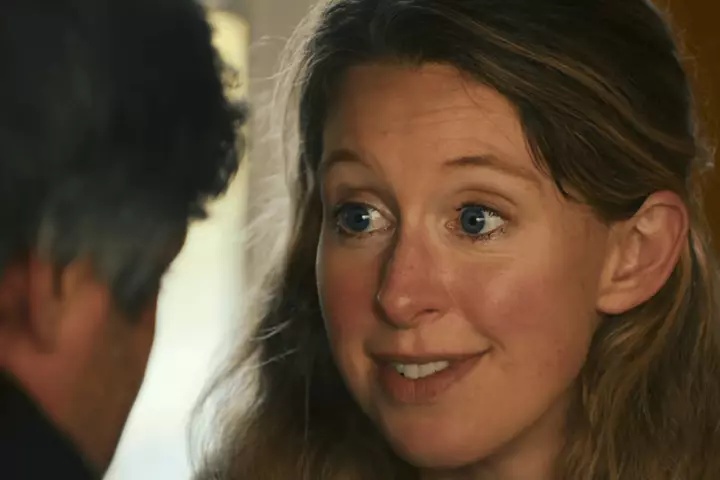
Watching “You Can See Everything,” people see themselves reflected in the post-ironic deadpan of Nathan Fielder, who is 42 and represents, from his television shows, a novel mode of fucking with people that’s intricate in its cleverness yet bizarrely honest. Having his close-up conversations with Elizabeth Holmes, he’s wily and detached, but he’s also a straight-shooter, asking rigorous questions about what we want to know: how Holmes could have lied the way she did, and, if she claims (as she does throughout the film) that she wasn’t lying, how she could possibly believe that. The movie, in a sense, is a cosmic meditation on lying. (Holmes sounds as monomaniacal, and as hard to fathom, in her systematic delusions as Donald Trump.) I think the Elizabeth Holmes showcased in “You Can See Everything” is a quintessential example of the human being as corporate performer — she’s doing a dance of put-on earnestness, and her act is so good that Fielder meets his match in attempting to unmask it.
The film is an almost dreamlike duel of egos. By making a movie in which he and his directing partner, Lance Oppenheim, literally didn’t know where they were going, Nathan Fielder has given us a documentary drama that’s all about discovery. That’s what gives “You Can See Everything” its cathartic existential entertainment value.
Extract — continue reading at the source.