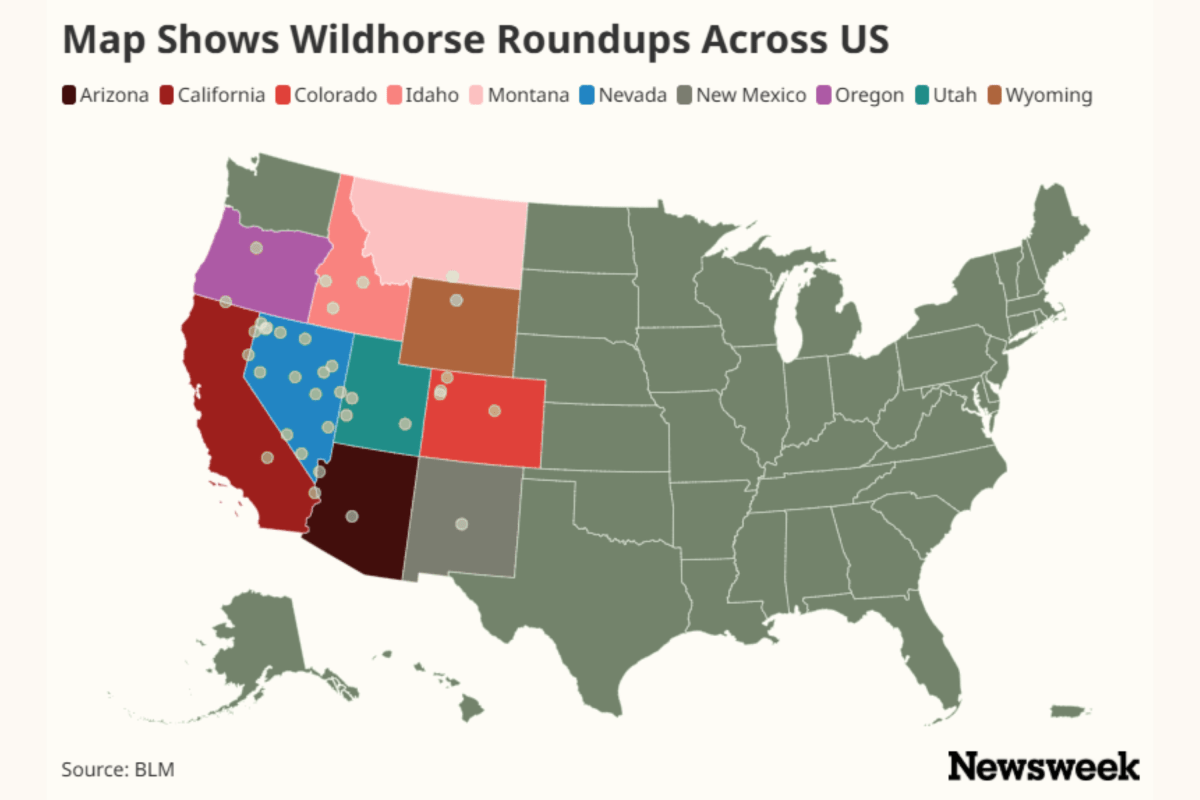
Thousands of wild horses and burros are being rounded up across the American West, as federal officials seek to reduce herd populations they say exceed what the land can sustainably support. The roundup operations are prompting renewed criticism from animal-welfare organizations, including American Wild Horse Conservation (AWHC), which says the animals face stressful and traumatic helicopter chases, family separation, long-term (sometimes permanent) confinement in government holding facilities, and can ultimately be at risk of entering the slaughter pipeline. Roundup reports published by AWHC have identified "inhumane" operations in the Piceance-East Douglas Creek area in western Colorado, the Bible Springs Complex in southwestern Utah, the Moriah and Lahontan areas in Nevada and the Saylor Creek Herd Management Area in southwestern Idaho, alongside earlier operations in California, Wyoming and other Western areas.
The federal government’s own schedule covers gathers, emergency removals and fertility-control work in numerous Western states. For instance, on or around August 23/24, the Bureau of Land Management (BLM) is due to begin an operation in Utah’s Confusion Herd Management Area, where it plans to gather and remove approximately 360 horses as part of the state's Appropriate Management Level (AML) plans to achieve a population range that the state can sustainably support while maintaining what the Wild Free-Roaming Horses and Burros Act calls a "thriving natural ecological balance on the public lands." A Wyoming operation, scheduled to begin on or after September 15, would remove approximately 286 horses from the Fifteenmile Herd Management Area. The BLM says that wild horse populations can sometimes exceed the number that available forage, water, wildlife habitat and other authorized land uses can support: "Chronic wild horse overpopulation in fragile ecosystems endangers overall land health, with the possibility of permanent, irrecoverable damage to important resources and impacts to other wildlife populations." So, to keep herd numbers at sustainable levels, the BLM periodically rounds up and removes excess horses and burros from overpopulated herds.
The agency also uses fertility control, sometimes during gathers, to slow population growth and reduce the need for future removals. In the Confusion area, for example, the agency has set an AML of between 70 and 115 horses. Contractors are expected to use helicopters to guide horses into temporary holding pens, after which the animals will be transported to a holding facility, examined by a veterinarian, and prepared for adoption or sale.
For the upcoming Fifteenmile gather in September, the agency estimates that 386 horses occupy an area where the established management level is between 100 and 230, which is why they’re planning to remove 286. Critics don’t necessarily dispute that some herds require management. Humane World for Animals, for instance, is in full public support of fertility control, carefully targeted non-lethal gathers, adoption and pasture placement.
Instead, they argue that federal policy relies too heavily on removing horses from the range and placing them in government-funded holding facilities rather than focusing on fertility control and keeping family groups together in the wild. Animal welfare groups also argue that some horses can ultimately enter the slaughter pipeline, even though, according to Humane World for Animals, "the slaughter of federally protected wild horses and burros is illegal." A recent New York Times investigation found that some animals in federal custody were being resold and transported to Canadian slaughter plants, despite BLM rules that say: "It has been and remains the policy of the BLM not to sell or send any wild horses or burros to slaughter." According to the report, the BLM has sharply increased sales of wild horses that it has classified as "unadoptable" after they receive no interest through the agency's adoption program. Once sold, rather than adopted, the horses immediately lose their federal protections under the Wild Free-Roaming Horses and Burros Act.
Although buyers must sign agreements promising not to slaughter the animals or knowingly sell them to someone who intends to do so, the Times reported that horses can be resold through intermediaries who are not bound by those contracts. The newspaper cited livestock auction records, border inspection documents and interviews with traders that it said showed some former BLM horses later appearing in livestock auctions and on shipments bound for Canadian slaughter plants. Animal welfare groups told the Times that the practice undermines the intent of federal protections for wild horses, while the BLM maintains that it does not sell or send wild horses for slaughter and says it remains committed to placing animals in good homes.
Extract — continue reading at the source.