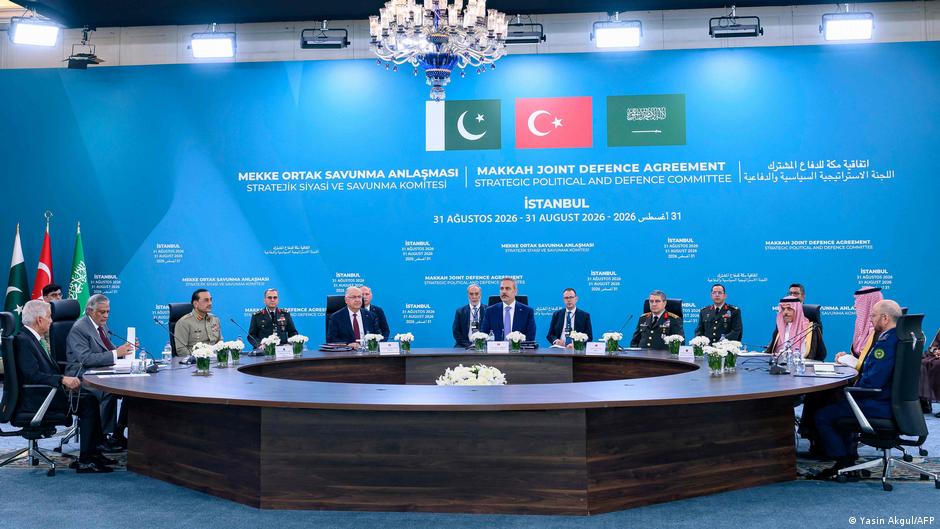
There has been widespread speculation about Bangladesh becoming part of a mutual defense deal struck last month by Saudi Arabia, Turkey and Pakistan. But the South Asian country says it has yet to receive an invitation. The "Mecca Joint Defense Agreement," signed into force in early August, is intended to strengthen collective deterrence against any act of aggression and stipulates that an armed attack against any of the three would be regarded as an attack on all.
Some analysts believe the pact has already changed the geopolitical landscape of the Middle East and South Asia. "Although it is a collective defense understanding, from a strategic perspective it is primarily an initiative to maintain the regional balance of power and advance the respective interests of the participating states," Navine Murshid, professor in the Department of Political Science and Sociology at North South University in Dhaka, told DW. To view this video please enable JavaScript, and consider upgrading to a web browser that supports HTML5 video Any move by Bangladesh to join, however, could complicate its foreign relations, particularly with neighboring India.
The two countries share a 4,096-kilometer-long (2,545 miles) land border, and have strong cultural and economic ties. India, a fierce rival of Pakistan, sheltered many Bangladeshi refugees and provided military support to Bangladesh during its independence war against Islamabad in 1971. However, ties between New Delhi and Dhaka have become increasingly contentious since a deadly student-led uprising in 2024 toppled then Bangladeshi Prime Minister Sheikh Hasina, who was considered a close ally of the Indian government.
Now living in exile in India, Hasina has since been convicted in absentia for crimes against humanity during the uprising. Bangladesh's current government, headed by the center-right Bangladesh Nationalist Party (BNP), is in favor of the Mecca agreement. "We view this pact positively," Bangladeshi Foreign Minister Khalilur Rahman said in response to a question in parliament last week.
But he insisted that the question of Bangladesh joining the pact, or even considering membership, had not yet arisen, as that would depend on the intentions of its current members. "If they express an intention to include Bangladesh in the pact, we will certainly consider it positively," he said. In response to a question about such remarks by Bangladeshi officials remarks, India said the pact had implications for its national security and that it was closely monitoring the situation.
"We continue to follow all developments that have a bearing on India's security and take all necessary steps to safeguard it," Randhir Jaiswal, spokesperson for India's Ministry of External Affairs, told reporters in New Delhi last week. Analysts say Dhaka needs to consider its interests carefully before making any move to join the joint defense pact. "The scope for direct conventional interstate war or military conflict in South Asia is limited.
Extract — continue reading at the source.