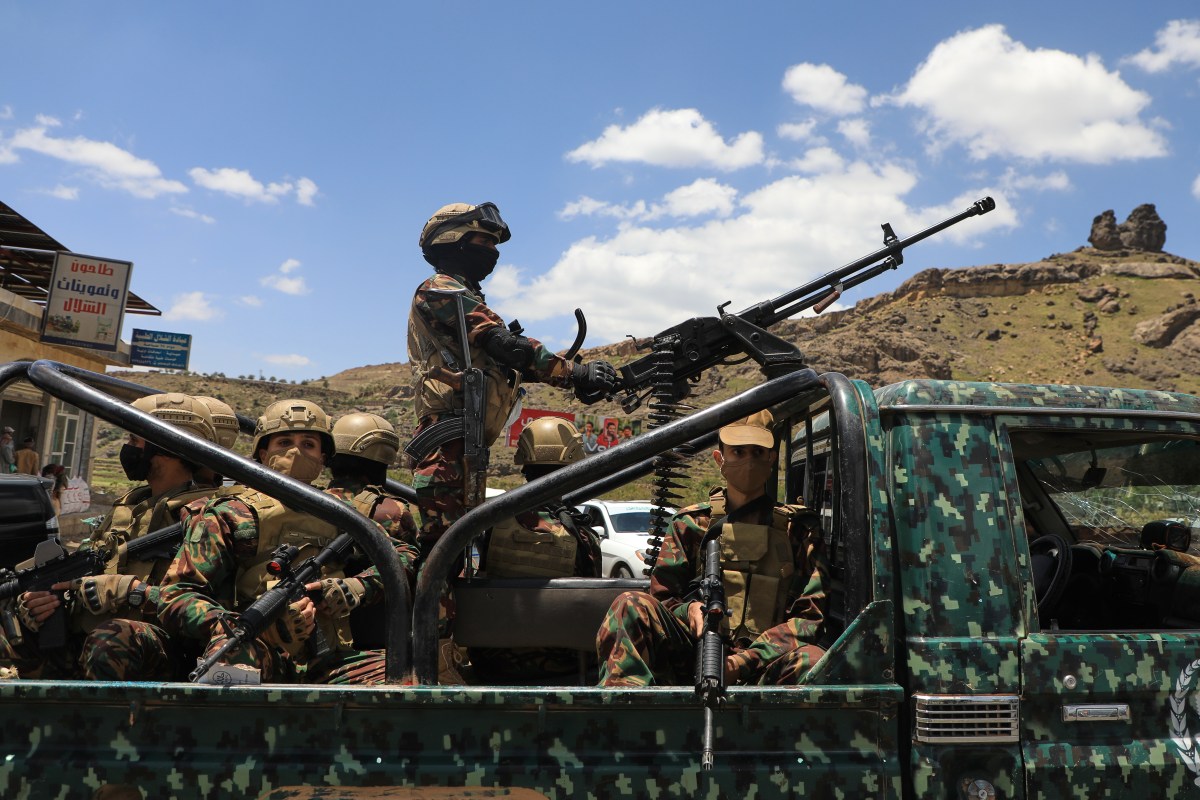
Iran's Yemeni ally Ansar Allah—widely known as the Houthis—has once again stunned the world with its intensified strikes on Saudi Arabia and lightning offensives against rival forces on the ground, putting the Axis of Resistance in control of yet another global energy trade chokepoint. Ansar Allah, having already demonstrated the capability to disrupt international shipping through past attacks on vessels in the Red Sea and nearby waters, now presides over the Bab el-Mandeb, a vital corridor to the Suez Canal whose strategic importance is magnified by dueling Iranian and U.S. blockades of the Strait of Hormuz. That's already bad news for both Saudi Arabia, now dealing with a suspected strike from another Iran-aligned faction in Iraq that damaged its East-West pipeline, and U.S. consumers, who are set to feel a new hit in the form of surging fuel costs as the U.S.-Israeli war against Iran continues to sow chaos in the oil and gas market.
But there's an even more dire scenario that limits the options of Washington and Riyadh, particularly the prospect of a full-scale invasion or intervention to rescue Yemen's internationally recognized yet increasingly embattled government. "Neither country is eager to send their forces to die en masse and instead prefer to rely on superior air power, which has proven repeatedly inadequate as a means of holding territory in Yemen and elsewhere," Annelle Sheline, a former U.S. State Department official serving as research fellow at the Quincy Institute for Responsible Statecraft's Middle East program, told Newsweek.
"In the event that Saudi Arabia convinced the U.S. to lead a multinational coalition to conduct a ground offensive in Yemen, it would quickly face similar dynamics as Iraq and especially Afghanistan, where the terrain allows for insurgency to operate, while the foreign occupier will eventually give up and leave," Sheline said. It certainly would not be the first time that a foreign power failed to achieve its goals in Yemen. Saudi Arabia led a coalition to intervene in the country in March 2015 following Ansar Allah's takeover of Sanaa, allowing government forces to regroup in the south but failing to displace the insurgent group from presiding over around a third of the country and 80 percent of its population.
A U.N.-mediated ceasefire in April 2022 largely froze the civil war's frontlines until the latest conflagration, sparked by a Saudi airstrike against Sanaa's airport in July, followed by retaliatory strikes by Ansar Allah and the group's rapid advance against Yemeni government forces along the west coast. Decades earlier, Egypt, then led by Arab nationalist President Gamal Abdel Nasser, also sought to influence events in Yemen when he sent troops to aid a revolutionary uprising against a Saudi-backed kingdom during a 1960s civil war in what is now the country's north. The campaign proved disastrous, with the stalemated Cairo-backed forces undergoing a coup that eventually resulted in Riyadh recognizing a more moderate republican government.
More than 10,000 Egyptian soldiers were killed in North Yemen between 1962 and 1967, and the strain of the conflict has been attributed as a factor in Egypt's lack of preparedness in the 1967 Arab-Israeli War. Nasser himself in 1967 would refer to the experience in Yemen as his "Vietnam," where U.S. troops were then attempting to take on communist forces in what became one of the deadliest confrontations of the Cold War. The U.S. withdrew in 1973 after suffering more than 58,000 dead over the course of eight years, leaving North Vietnam and its Viet Cong guerrilla allies to dominate and unite the divided Southeast Asian nation by 1975.
Sheline pointed out that, "certainly the Saudi-backed Yemeni government has parallels to the U.S.-backed government of South Vietnam." And she highlighted an even more recent analogy of the limits of superpower might against a deeply entrenched foe, that of "the collapse of the U.S.-backed government in Afghanistan in the face of the Taliban's advance following the U.S. withdrawal" in August 2021. The exit put an end to a 20-year intervention—the longest war in U.S. history—that resulted in the deaths of nearly 2,500 U.S. personnel. "In many ways, I see the Taliban as similar to the Houthis, in their repression of women and minorities, but also that they have tapped into the population's sense of nationalism as the defenders of Yemen's sovereignty in the face of foreign military intervention and occupation," Sheline said.
Extract — continue reading at the source.