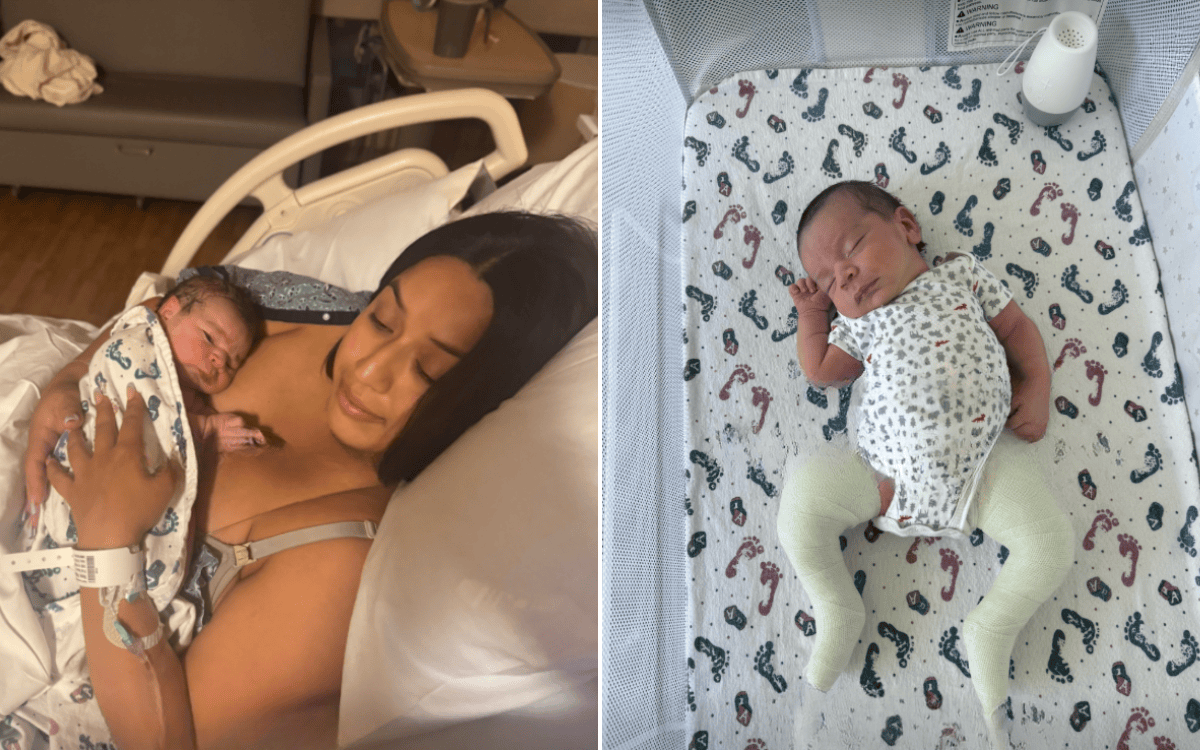
From the moment her son arrived in the world, mom of three Michelle Reyes could see that he was different. Reyes, who is from Buena Park, California, remembers her third pregnancy as being the hardest. "My pregnancy with Tommy was really hard on my body," she told Newsweek.
"I asked for a chair at work because I was struggling to stand for long periods." However, no scan or doctor ever identified anything during that time to give them cause for concern. "All of my tests came back looking good," Reyes said. "As far as I knew, I was going to have a healthy baby boy." As soon as Reyes gave birth to her son Tommy, however, she became concerned.
"The first thing I noticed was his feet. They were both severely turned inward," she said. "The nurses reassured me and said he had probably just gotten comfortable in the womb and that it shouldn’t be anything to worry about." A few days later, while she was still in the hospital recovering, Reyes was visited by a specialist who wanted to take X-rays of Tommy’s feet.
"That’s when we were told for the first time that Tommy had been born with severe bilateral clubfoot," Reyes said. This is a birth defect that causes both feet to turn inward and downward. According to the CDC, it affects roughly one in every 1,000 babies born in the United States, with both feet involved in around half all cases.
Hearing those two words was a shock to the system for Reyes. "It was definitely a lot to take in because we had gone through the entire pregnancy thinking everything was completely fine," Reyes said. One of the strangest parts about what happened was that, just weeks earlier, Reyes had randomly watched a video on social media about a baby with clubfoot.
"I had never heard of clubfoot before, so I just scrolled past it and didn’t really think anything of it," she said. Now it was becoming a reality for her and her family. Reyes remembers her first thought being: "What did I do wrong?" "I started blaming myself," she said.
Extract — continue reading at the source.