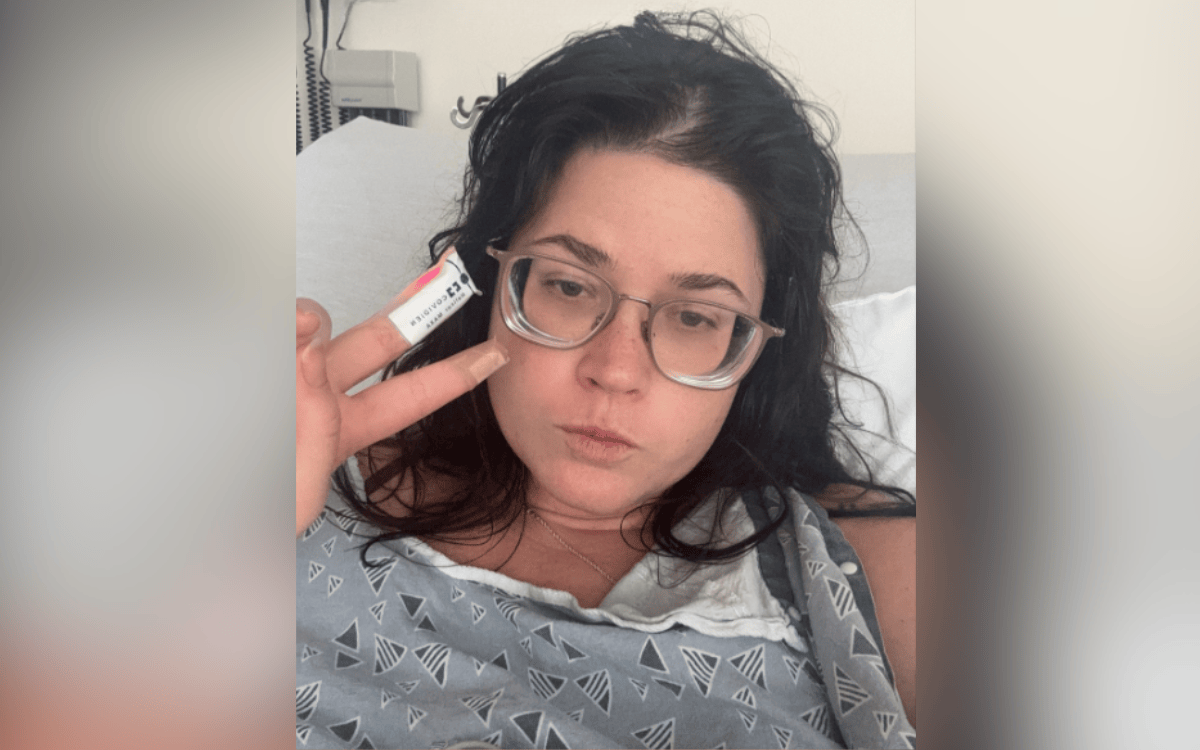
When Destiny Amos first went to the emergency room, she thought the dizzy spells and brain fog she was struggling with were because of low blood sugar. What she wasn't prepared for was what would show up on a CT scan of her brain. Amos, from Jacksonville, Florida, can't remember when her symptoms first started, but she remembers things beginning to "get bad" this past June.
"I began feeling very dizzy and like I was swaying even while standing still. I had constant brain fog, pressure in the lower left side of my head, and episodes where the left side of my face felt numb," Amos told Newsweek. Amos remembers feeling unusually anxious and having a general sense that something, somewhere in her body, was seriously wrong.
Matters finally came to a head one night when she woke up and didn't recognize where she was. "I was extremely unsteady and dizzy, felt nauseous, and felt like my heart was beating out of my chest," she said. Amos's mom called 911, and she was taken to a nearby ER.
When Amos spoke to her doctor, she explained that she had been experiencing what felt like "episodes of low blood sugar." She had been diagnosed with blood sugar issues before and wondered whether her dizziness and nausea could be linked to them. Her doctor ordered a CT scan of Amos's abdomen as well as her brain. Amos said that when he eventually returned with the results, he told her: "Well, this certainly explains your symptoms." "The CT scan showed an approximately 3 cm suspected meningioma in the posterior fossa area of my brain that was pushing against my cerebellum and causing mild mass effect," Amos told Newsweek.
A meningioma is a tumor that forms in the membranes surrounding the brain and spinal cord. While usually noncancerous, it is the most common type of primary brain tumor in adults, accounting for around one-third to 40 percent of cases in the United States. According to the American Brain Tumor Association, women are affected by meningioma more often than men, and the risk increases with age.
Though meningiomas are classed as brain tumors, they do not grow from brain tissue but rather the meninges, the three thin layers of tissue that cover the brain and spinal cord. Following the scan, Amos was transferred to a larger hospital, where she underwent an MRI so doctors could get a better look at the tumor. She ended up spending the next month in the hospital before undergoing surgery.
Extract — continue reading at the source.