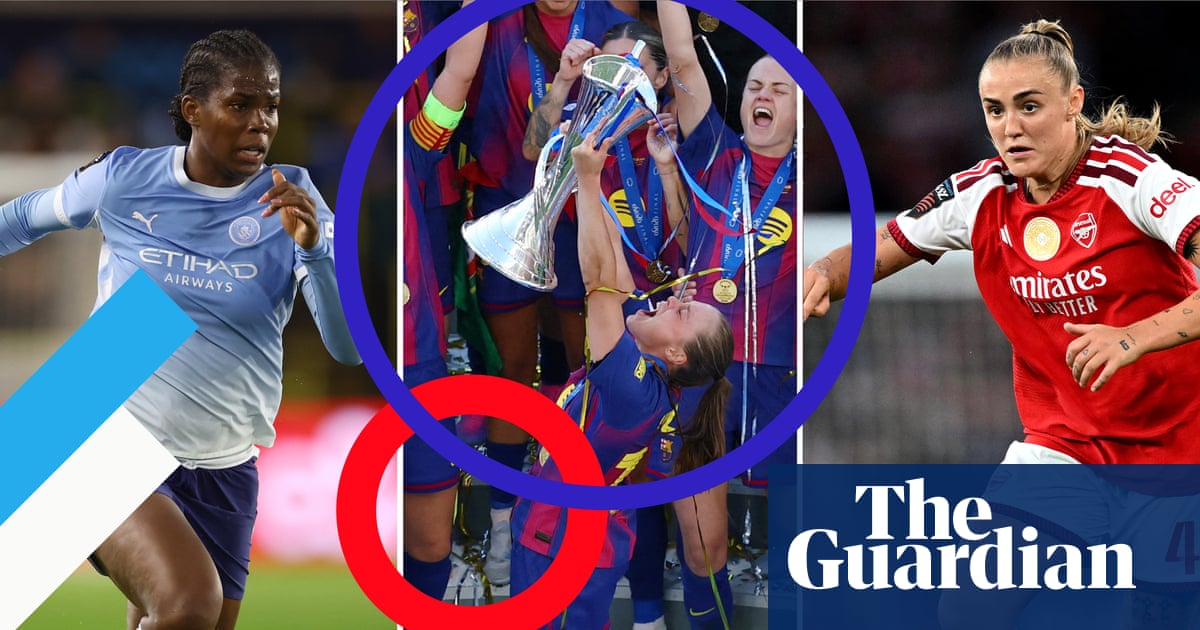
The league phase of a new Women’s Champions League campaign begins on Tuesday with genuine elements of unpredictability, intrigue and a competitive feel after Barcelona, the holders, and winners of four titles in six years, underwent significant changes this summer. The Spanish champions, who have reached six European finals in a row, have had four players who started the victory in the final last season leave the club. Ona Batlle joined Arsenal, Salma Paralluelo signed for OL Lyonnes – against whom she scored twice in that 4-0 victory to clinch the title in May – and Alexia Putellas and Mapi León moved to London City Lionesses.
They have a very different look and feel to the formidable aura they demonstrated in Oslo. They are still the team to beat, though, and retain an excellent squad, including the winner of the last three Ballons d’Or in Aitana Bonmatí – although she is doubtful for their opener against Paris FC on Wednesday with injury – as well as the top scorer in the competition last season, Ewa Pajor, and their captain, the Spain midfielder Patri Guijarro. It will still take a world-class team to topple them, but there is perhaps no longer that same air of invincibility accompanying them this time.
Hoping to capitalise and reclaim a title they have not won since 2022 – a relatively long wait given they are the record eight-time winners – are OL Lyonnes. They had a comparatively good transfer window, adding Paralluelo, who scored her first goal for the club on Friday during an 8-1 demolition of Le Havre, and the Scotland midfielder Caroline Weir, who joined after four years at Real Madrid. Lifting the European Cup would be a defining achievement for their owner, Michele Kang, who also owns Washington Spirit and London City Lionesses, and for their head coach, Jonatan Giráldez, if he could win the competition with a second team after his back-to-back successes with Barcelona in 2023 and 2024.
Bayern Munich should be in contention along with a trio of English sides – Arsenal, Chelsea and Manchester City – all of whom have the squads and resources to mount significant challenges. Arsenal, winners in 2025 – and 2007 when the competition was known as the Women’s Cup – remain the only English club to have won major European silverware, which feels at odds with the modern-day big spending in the WSL and the division’s frequent jostling with the NWSL for the unofficial title of the “best league in the world”. The WSL’s three most successful sides, for all their financial investments, are yet to dominate in Europe, and that could begin to change this season.
Arsenal strengthened the depth in their squad this summer, not least with the arrivals of Georgia Stanway from Bayern and Batlle from Barcelona. Their ability to bring top-level internationals on from the bench in almost every position should make them a real force. Manchester City, the English domestic champions, reached the quarter‑finals in 2025, but missed out last season, and have something of a point to prove and a desire to make up for lost time.
They were absent from Europe in 2023-24 as well and failed to make it past the qualifying rounds in the 2021-22 and 2022-23 seasons, when they were knocked out by Real Madrid on both occasions. They were also eliminated relatively early by another side from the Spanish capital, Atlético Madrid, in 2018-19 and 2019-20, so they have not reached the semi-finals since 2017-18, a barren run which felt unlikely at the time. They were delighted to retain the services of the WSL’s top scorer, Khadija Shaw, and it will be fascinating to watch the Jamaica striker unleashed on Europe’s biggest club competition.
Extract — continue reading at the source.