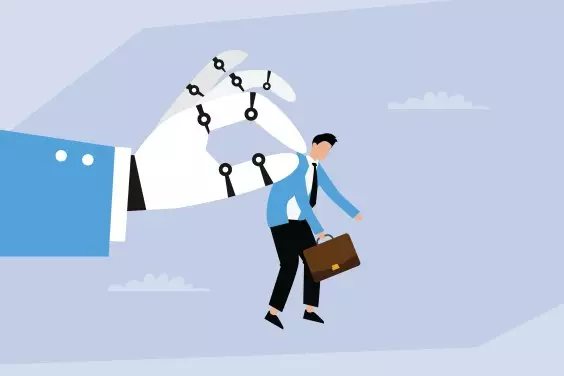
Just a few years ago, the leaders of major AI companies undertook a rather bizarre public relations strategy to promote their new products—they promised (threatened?) that they’d wipe out entire industries. Now, with public backlash to AI data centers in particular reaching a fever pitch (and an oddly bipartisan one, given how politically polarized we are), tech titans are scrambling to recalibrate. They’re backing off previous claims of a “jobs apocalypse” and promising AI disruption will be much less, well, disruptive.
Read more: “Mere Minutes With AI Causes a Sharp Drop in Persistence” It’s too early to tell if the about-face will work as a matter of public relations, but there are at least some hints that their earlier PR blitz is harming the workers in industries exposed to AI disruption. In fact, a new study published in Occupational Health Science suggests the mere threat of AI could be throwing a wrench into workplace dynamics. A team of researchers led by psychologists from Washington State University submitted three waves of questionnaires to workers in 18 different industries designed to measure a few things.
The first metric was occupational insecurity, or how worried workers were about AI potentially taking their jobs. Next, the team asked about their attitudes toward moral workplace norms. Finally, they asked about how likely they were to engage in counterproductive workplace behaviors, like slacking off, stealing supplies, or wasting resources.
The team found that workers who were more worried about AI taking their jobs were more likely to morally disengage at work and also engage in counterproductive behaviors. These self-reported effects were attenuated among those working in industries with less exposure to AI, like forestry and agriculture. However they were amplified in industries more directly threatened by AI, like finance and insurance.
Probst of Washington State University explained in a statement. We know what organizational policies say we can and can’t do. Moral disengagement is a way of reframing that behavior as something that is acceptable.” Of course, ethering entire job sectors is also a kind of norm violation, so it makes some sense that those affected might take a more relaxed attitude toward comparatively smaller workplace norms.
But these findings suggest the mere threat could be disruptive. They also offer a warning for employers who are just trying to augment their current human workforce with AI: “To minimize negative outcomes for workers from AI adoption, positions within high AI exposure industries should consider whether AI is being adopted through strategies that reduce threat perceptions toward their occupation.” Enjoying Nautilus? Subscribe to our free newsletter.
Extract — continue reading at the source.