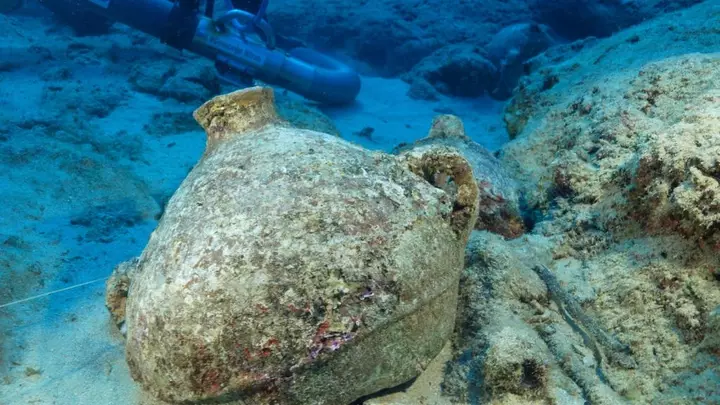
The world's oldest shipwreck has been discovered off the coast of Turkey, archaeologists say. They have dated it to between 4,400 and 4,700 years old, which is the Early Bronze Age, and is around the same time that the Great Pyramid was being built. The ship's wooden structure has not survived, but the ceramic storage pots it was carrying were lying on the sea floor and, remarkably, some still contain traces of what they held inside.
The archaeologists who found the ship say it was about 10m in length and was a trade vessel carrying cargo across the Mediterranean Sea. "The shipwreck is a time capsule at the bottom of the sea," said Prof Hakan Öniz, from Akdeniz University in Turkey, who led the Mediterranean Archaeology Association expedition. The wreck is close to the shore of Kekova Island in Antalya, Turkey.
The artefacts lie scattered across an underwater slope, just 30m beneath the waves. Three large stone anchors were found, as well as more than 30 ceramic storage pots, called amphorae. The fact that none of the ship's wood remained meant techniques like radiocarbon dating - which measures a form of carbon in organic materials - could not be used to determine its age.
Instead, archaeologists analysed the shape of the amphorae. Because pottery styles have changed over time, differerent styles are linked to particular periods. The Kekova ceramics are distinctive, with two handles, a ridge in the middle and a flat base.
Öniz said this design matched other amphorae unearthed in Egypt and the Middle East that were known to be 4,400-4,700 years old. "Comparing the decoration techniques… we can definitely say our wreck is Early Bronze Age. This is 100%." Divers from the expedition brought the pots up to the surface, where they are now being carefully conserved after so many thousands of years underwater.
Dr Karin Sowada, an archaeologist from Macquarie University, Australia, examined the amphorae after they were recovered. Some were intact and she was surprised to see they still contained a viscous, glossy residue. "I looked inside and nearly fainted.
Extract — continue reading at the source.