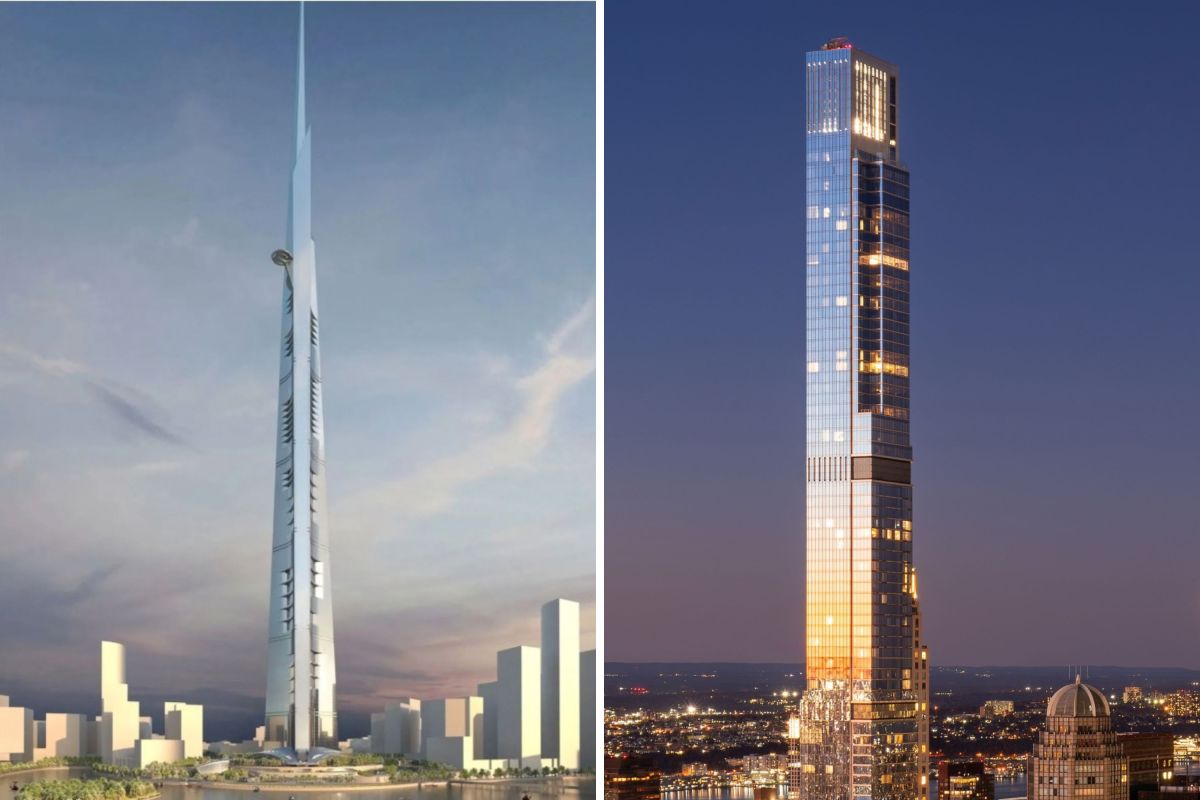
The Jeddah Tower in Saudi Arabia, which will be the world’s tallest building upon completion, has marked a new construction milestone this week. Engineer John Peronto, managing principal at Thornton Tomasetti and project manager for the tower, told Newsweek on Tuesday that “the Jeddah Tower has now surpassed the world’s tallest all-residential tower, Central Park Tower in New York City, and is nearing 500 meters [over 1,640 feet].” The Central Park Tower is just over 472 meters (over 1,550 feet) tall. Peronto added: “It has been an incredible achievement by the team to get to this point.” Designed by architects Adrian Smith and Gordon Gill, co-founders of AS+GG, and constructed by Saudi Binladin Group (SBG), once completed, the Jeddah Tower will rise to over 1,000 meters (around 3,281 feet) high, surpassing the Burj Khalifa in Dubai, the current world’s tallest building, which stands 2,717 feet high.
The final height of the Jeddah Tower will be revealed upon completion. The Burj Khalifa was also designed by Smith while he was at the SOM (Skidmore, Owings & Merrill) architectural firm, before he co-founded AS+GG. The news of the latest milestone was also highlighted by SBG senior executive project director Ian Norman Miller in a post on LinkedIn on Tuesday.
The director noted that the Jeddah Tower had reached a height of around 474 meters (around 1,555 feet), roughly the height of the Wuhan Greenland Center in China, in addition to the Central Park Tower, which are the world’s 14th and 15th tallest buildings, respectively, according to the Skyscraper Center of the Council on Vertical Urbanism. The recent feat comes just after the record-breaking skyscraper marked another notable milestone last month, surpassing Malaysia’s Petronas Towers, which at 452 meters (around 1,483 feet) was once the world’s tallest building in 1998. The megatower's construction continues amid a call to adaptively reuse and improve existing buildings, given the growing environmental impact of building new structures.
Among the proponents of this approach is the Jeddah Tower’s architect, Gill, who told Newsweek earlier this year that height is no longer the primary goal when asked about the next architectural benchmark he’d like to achieve. Gill said the future of architecture lies not in building higher but in rethinking what we already have. He previously told Newsweek: “Sustainability is what matters to me the most…to get to the point where we're contributing with buildings and turn them into assets, versus looking at them as deficits.” According to the American Institute of Architects (AIA), nearly half of America’s 125 million buildings are at least 50 years old, and adaptive reuse is gaining ground.
In 2024 alone, about 25,000 apartments were created through building conversions nationwide—a roughly 50 percent increase year over year, according to RentCafe. AIA says reusing existing buildings can avoid 50 to 75 percent of the carbon emissions associated with new construction by reducing the “embodied carbon” released through the manufacturing and transportation of building materials. The Jeddah Tower’s engineer Peronto told Newsweek: “Soon, in 2027, steel erection for the ‘sky terrace’ will also begin." The sky terrace is the upper observation level around the 160th floor, Peronto told Newsweek in June.
At the time, the engineer said the tower was expected to reach the 500-meter mark in roughly 25 weeks’ time from June, and that the construction was moving at an estimated rate of around 4 meters (about 13 feet) a week. Architect Bob Forest, partner at AS+GG, told Newsweek last month that the tower continues to juggle engineering challenges, such as developing a structural system that can work efficiently at record-breaking heights. Forest said: “With the team’s dedication to the process, Jeddah Tower is on track to meet its planned completion date” of August 2028.
Extract — continue reading at the source.