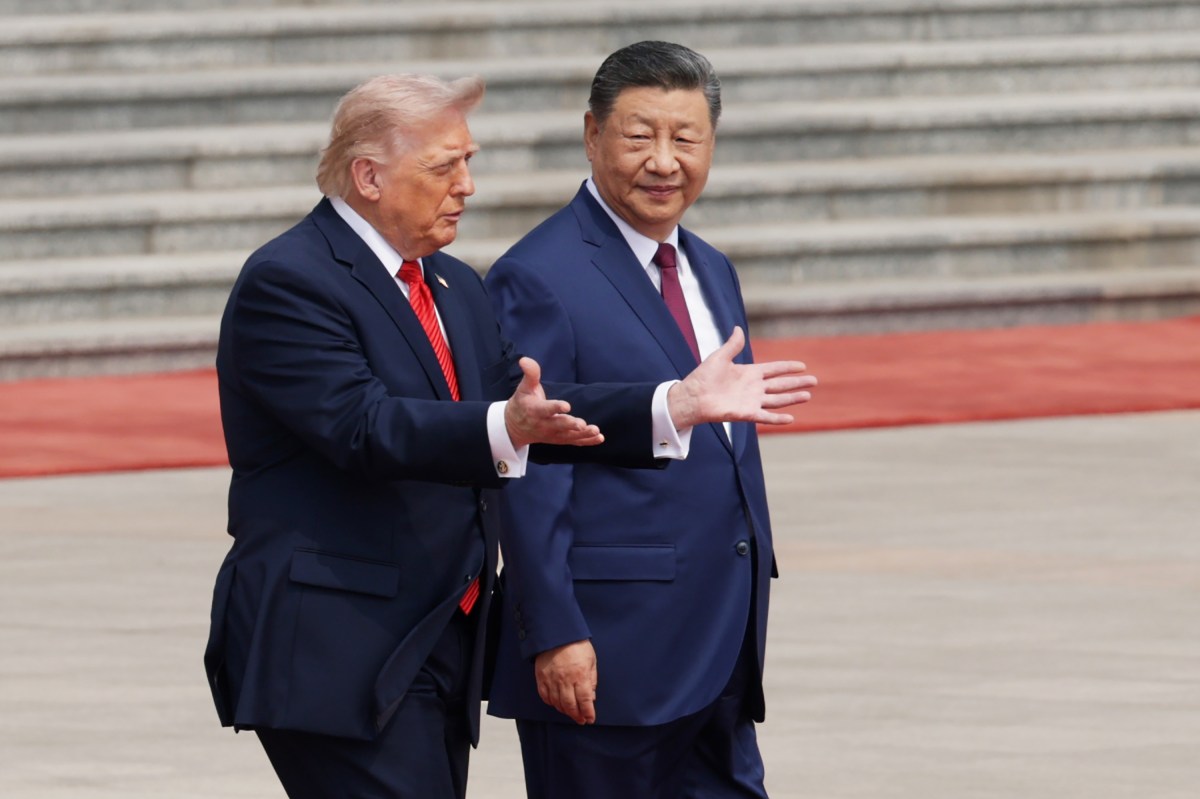
President Donald Trump is set to meet with his Chinese counterpart, Xi Jinping, whose recent public absence has sparked speculation about his health. Xi is due to arrive on Wednesday at Joint Base Andrews in Maryland, outside Washington, D.C., where he is expected to be greeted personally by Trump ahead of a highly anticipated White House meeting on Thursday, with trade, Taiwan and tariffs on the agenda. This would be Xi's first appearance since September 13, when he was last seen in public at the BRICS summit in New Delhi, whose media reported that he skipped the dinner hosted by Indian Prime Minister Narendra Modi.
Wanjun Xie, the chair of the China Democratic Party, an outlawed opposition party, has promoted claims on social media that Xi, 73, fell ill during the BRICS opening ceremony and was removed to get first aid treatment before being flown back to China. The unsubstantiated claims follow a purge of military officials in China, where strict censorship makes Xi's health the subject of speculation. "Xi occasionally disappears for some days, so it's not necessarily a sign of major problems," Steve Tsang, the director of SOAS University of London's China Institute, told Newsweek on Wednesday.
"After several foreign trips, he may want a bit of downtime before the Washington visit. I am aware of some dissidents' speculation that Xi had health problems, but so far this is not proven, though not impossible," he added. Newsweek has contacted the Chinese Foreign Ministry for comment.
When Trump returned to the presidency in 2025, he used tariffs to pressure Beijing over fentanyl, trade and other economic disputes. Beijing retaliated with its own high tariffs before a truce took hold, which was strengthened by Trump's state visit to China in May. However, Allen Carlson, an associate professor of government at Cornell University and an expert on Chinese foreign policy, said the U.S. is entering the meeting with less leverage than earlier this year.
"Trump and his advisers are approaching this visit as if America won the last round in Beijing and will win again. It did not," he told Newsweek. The war in Iran has meant that U.S. munitions have been expended faster than they can be replaced, which requires the rare earths that China possesses.
"Xi, meanwhile, has just completed his most extensive trip abroad since before the pandemic, pitching China as the stable alternative to an erratic America," Carlson added. In analysis shared with Newsweek, Oxford Economics said the leaders' meeting is a sign that the U.S.-China relationship is becoming more predictable, although "the hawkish bias in both sides' foreign policy will persist." China wants to preserve export access while reducing external technology dependence, Oxford Economics said. Meanwhile, the U.S. will be keen to limit near-term supply chain disruption and build manufacturing capacity at home.
Extract — continue reading at the source.