I once had an argument about Yayoi Kusama with Peter Gabriel. Not in person – I’ve never met the prog rock hero. But after I recorded some critical comments on her work for the BBC, I watched the segment only to see Gabriel passionately defending her.
My onscreen cynicism seemed harsh indeed compared with his soulful appreciation of all those dots. My scepticism about Kusama started the first time I saw her work at the Museum of Modern Art in New York. The context is significant because after a big dose of Jackson Pollock’s looping, tangled forests of colour and line (colour as line), Piet Mondrian’s pulsing Broadway Boogie Woogie and other great abstract art, Kusama’s dots appeared to me static, planned, predictable.
I wasn’t excited or moved. Well, things grow on you, or perhaps you just give up resisting when something is everywhere. Kusama is truly ubiquitous, not just in galleries but social media, her moving life story adding to the popularity of her art, her cosmic sensibility carrying global audiences along on psychedelic journeys into a natural world supercharged with outsized pixelations.
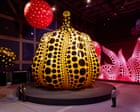
It was hard to resist her vision when I caught up with the Kusama phenomenon at Aviva Studios, Manchester, where vast installations and inflatables of dot-covered octopus tentacles and giant pumpkins made an industrial space feel enchanted and sublime. But I can still walk into a Kusama mirror room and see just an infinity of nothing. And when I come across one of her pumpkins at an art fair or biennial, it can be extraordinarily blank, a by-the-numbers exercise in commodified multiple art.
The Kusama cult has grown alongside and inside a contemporary art world of slick worldwide galleries, with branches from LA to Hong Kong, and a clientele of one percenters who buy art like jewellery. Her work has an obvious decorative appeal to this modern art market: one of those big spotty fruits would be great by the pool. In truth, there’s little connection between Kusama’s troubled life and anti-war activism and the feelgood vibes of her art.
Those lurid greens and oranges punctuated by lines of little black circles cannot really be experienced as marks of trauma or expressive howls. Instead they create a dreamy utopia. There’s nothing wrong with that.
Extract — continue reading at the source.