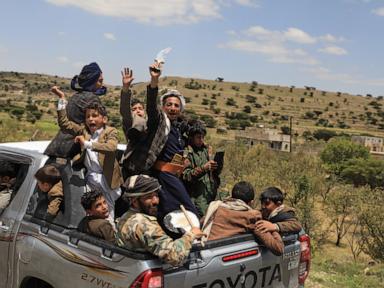
Yemen's factions fighting the Iran-backed Houthis are united in opposing the rebels who control the country's north and now its Red Sea coastline CAIRO -- CAIRO (AP) — Yemeni factions fighting the Iran-backed Houthis are united mainly in one thing — their opposition to the rebels who control the country’s north and have recently advanced along its Red Sea coastline. But beyond that, the groups fighting under the banner of Yemen's internationally recognized government are divided by geography, foreign patronage and competing visions for what their country should look like if the Houthis are pushed back. In a month of intense fighting that saw the Houthis' biggest land grab in years, factions of the anti-Houthi coalition lost their hold of Mokha, a strategic city on the Red Sea, and islands in the Bab el-Mandeb Strait further south.
The advance ended a truce that had been in place since 2022 and had calmed a devastating civil war. Neighboring Saudi Arabia is trying to weld the factions — amounting to thousands of fighters — into a more unified force, but their divisions have raised questions about their ability to halt the Houthi offensive that now has the rebels perched on one of the world’s busiest waterways. The Houthis' unified command and goals have helped their swift expansion, rather than any single military advantage, said Adam Baron, a fellow at New America, a Washington-based think tank.
Here is what we know about the anti-Houthi factions: Saudi Arabia formed a coalition to fight the Houthis in 2015, a year after the rebels overran the Yemeni capital, Sanaa, and much of the country's north, driving the government into the south. In the south, an array of militias and armed groups arose over the years, ostensibly to back the government against the rebels. Over the years, rivalries grew between Saudi-backed factions and others backed by the United Arab Emirates, as the two regional powerhouses competed for control over the coalition as well as Yemen’s coastal regions overlooking strategic shipping lanes.
The factions repeatedly clashed on the ground. After Emirati-backed southern separatist factions intensified clashes last year, Saudi Arabia carried out airstrikes against a suspected Emirati weapons shipment to southern Yemen. In January, the UAE said it pulled out of Yemen’s war, ending its support for factions on the ground.
Now as a single patron, Saudi Arabia is trying to absorb under its command and funding structure the factions that spent years operating with other loyalties. Some commanders have been reluctant to give up autonomy and their own revenue sources. A main faction is the National Resistance Forces, established in 2017 and long backed by the UAE.
With an estimated 30,000 fighters, it has been considered one of the best-armed factions, according to the Washington-based Middle East Institute. It was the main group holding Yemen’s Red Sea coast but not the only one. The Giants Brigades was also part of the command overseeing the coast.
Extract — continue reading at the source.