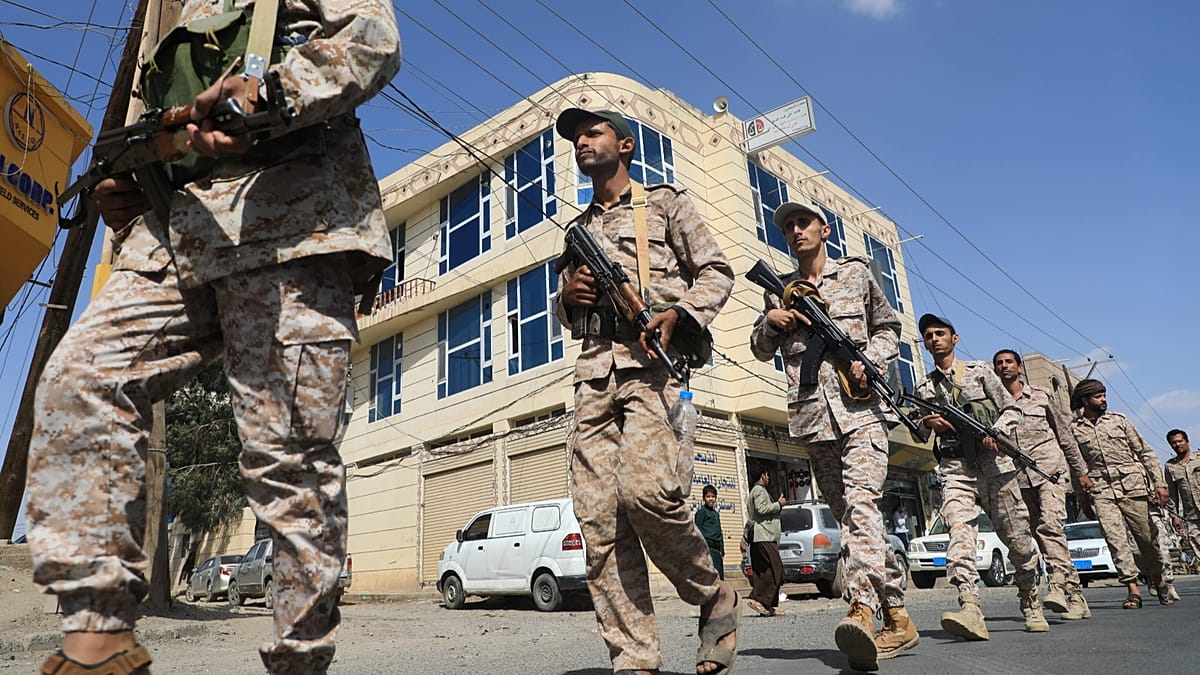
Yemen's Houthis have assured Washington that they would not attack US vessels in the Red Sea, following reports that the US cancelled its planned strikes on the group at the last minute, a senior Houthi official said on Monday. Mohamed al-Bukhaiti, a member of the Houthis’ political bureau, said Washington reached out to the group after their rapid advance down Yemen’s western coast to the Bab el-Mandeb strait earlier this month. He said the Houthi attacks against neighbouring Saudi Arabia will persist until Riyadh ends its decade-long blockade on Houthi-held areas in Yemen and allows vessels to reach Red Sea ports controlled by the group.
Then they will be ready to negotiate, he said. Al-Bukhaiti's comments came after US media reported that US President Donald Trump on Sunday pulled back from striking the Houthis at the last minute, just hours after deciding to target the Iran-backed group's positions following a call with Saudi Arabia's de facto leader Crown Prince Mohammed bin Salman. In an earlier indication that the US was mulling joining the fighting on Riyadh's side, Trump cut short a weekend at Camp David, a secluded presidential complex in rural Maryland, to return unexpectedly to the White House.
The White House gave no explanation for the early return or comment on the reports. Instead, the US warned on Sunday that fighting between Saudi Arabia and the Houthis could surge after a missile attack targeted Riyadh for the first time since the war in Yemen resumed. Loud explosions rang out on Saturday in the Saudi capital and a fuel tank bearing the logo of oil giant Aramco caught on fire in an apparent strike on Riyadh airport.
"This military conflict has the potential to escalate rapidly," the US State Department warned, adding US citizens outside the Middle East should "seriously reconsider travel to and through the region". Separately, the State Department restricted travel for US government employees to the Saudi cities of Taif and Yanbu, home to a major Red Sea oil export terminal that has previously been targeted by Houthi strikes. In recent weeks, the Houthis' lightning offensive seizing swathes of Yemeni territory has left hundreds dead and, according to the UN refugee agency, displaced more than 110,000 people.
The Houthis captured Yemen's Red Sea coast and key islands in an apparent plot to take control of the Bab el-Mandeb, a waterway that is crucial to energy flows and global shipping which has become even more strategic since Iran imposed a blockade on the Strait of Hormuz. The Houthis have insisted that there is no threat to navigation in the Bab el-Mandeb except for Saudi vessels. The fighting has already disrupted exports from Saudi Arabia, the world's leading supplier of crude oil, as well as maritime traffic.
The US has sent mixed signals to its ally Saudi Arabia since the Houthi offensive began in July. According to US media reports, Washington last week refused repeat Saudi requests to strike the Houthis. Trump said last weekend his administration “had discussions” with the Houthis, but did not say when.
Extract — continue reading at the source.