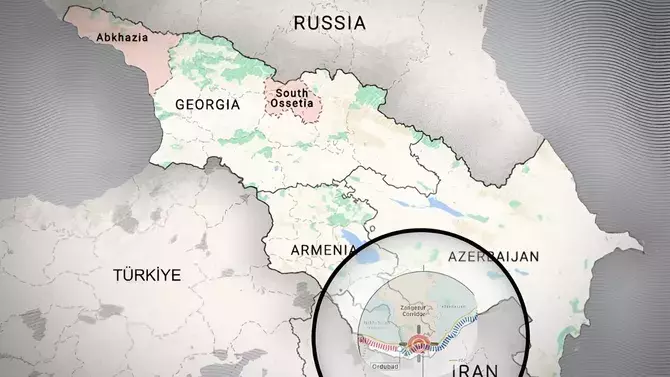
TRIPP could reshape Eurasian transport links and strengthen Azerbaijan’s position as a regional logistics hub, but competing interests among Washington, Moscow, Tehran and regional capitals will determine whether the project delivers lasting economic gains. The proposed Zangezur corridor is emerging as one of the South Caucasus’s most consequential geopolitical and economic projects, with implications extending well beyond the restoration of a transport link between mainland Azerbaijan and its Nakhchivan exclave. Its potential to connect Türkiye with the Caspian Sea and Central Asia more directly has placed the route at the intersection of regional trade ambitions, energy security and competition among global powers.
Given its benefits for Azerbaijan, the corridor could reduce transport costs, expand access to international markets and reinforce the country’s ambitions to become a key logistics hub along the Middle Corridor linking China and Europe. For Armenia, it offers the prospect of new trade and infrastructure investment, although questions over sovereignty, border controls and security remain central to negotiations. For the United States, Russia and Iran, the project represents a potential shift in the strategic balance of the South Caucasus.
The central question is no longer simply whether a railway or road can be built. It is whether the countries involved can establish a workable system of transit, security and commercial governance that distributes the benefits without creating new sources of confrontation. Zangezur’s strategic importance stems from its location.
The historical region encompasses areas now within Armenia and Azerbaijan, including territory around Syunik, as well as districts such as Lachin, Gubadli and Zangilan in Azerbaijan. Its mountainous terrain and position between the Caspian region, Türkiye and Iran have made control over its transport routes a recurring source of geopolitical competition. The historical account underpinning the project argues that the territorial changes of the early 1920s severed a vital land connection between mainland Azerbaijan and Nakhchivan, creating a division that subsequently shaped regional transport and security arrangements.
It also highlights the displacement of the region’s Azerbaijani Muslim population during the violence of the early twentieth century. The scale, causes, and political interpretation of these historical events remain contested and require careful examination of archival records and independent scholarship. Nevertheless, the geographical consequence is clear: Azerbaijan and Nakhchivan have lacked a direct land connection through Armenian territory, making alternative routes economically and strategically important.
For Baku, restoring direct connectivity would address a long-standing logistical constraint while strengthening links with Türkiye and the wider Organisation of Turkic States. It would also give Azerbaijan an additional instrument for diversifying trade routes at a time when Eurasian transport networks are being reshaped by geopolitical tensions and efforts to reduce dependence on established corridors. TRIPP could strengthen Azerbaijan’s logistics ambitions The Trump Route for International Peace and Prosperity (TRIPP), also known by its historical name as Zangezur, is presented in the source material as a means of reconnecting Azerbaijan with Nakhchivan through modern Armenia’s Syunik province.
Extract — continue reading at the source.