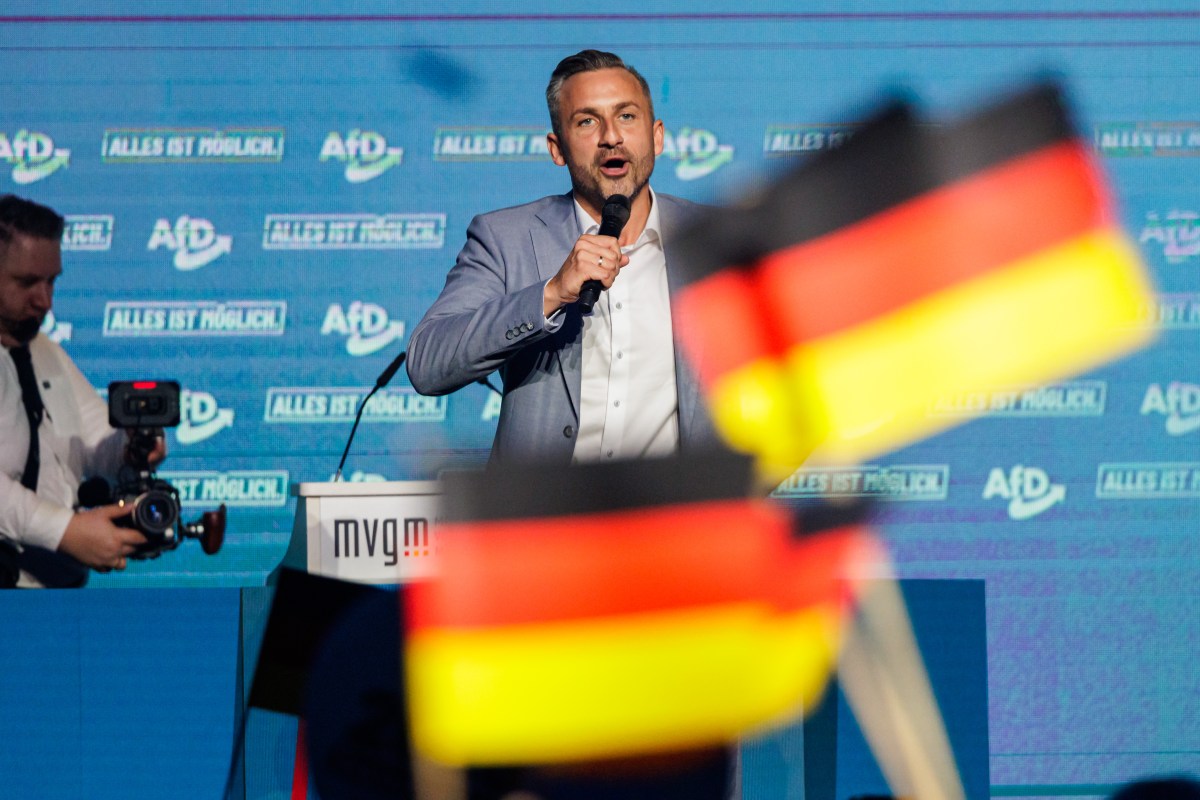
It is a seismic moment in German politics, one that may signal a much bigger change is coming with consequences that reach far beyond its borders. The far-right Alternative for Germany (AfD)—a favorite of President Donald Trump's MAGA movement and strongly endorsed by billionaire Elon Musk—has won 43.8 percent in Saxony-Anhalt's state election in the preliminary count, more than doubling its 2021 share and taking 39 of 83 seats, three short of the 42 needed to govern alone. Chancellor Friedrich Merz’s conservative CDU took just 17.2 percent and 15 seats, while turnout rose to 77.8 percent from 60.3 percent in 2021.
He faces some difficult choices ahead. The result reads best as five separate stress tests, and they do not all point the same way. Merz has tightened migration policy and asylum claims have fallen.
A DW fact check found first-time applications down 35.4 percent year over year in the first half of 2026, while noting that the decline began before he took office. The research firm Infratest dimap’s provisional voter-transfer analysis attributed about 170,000 AfD votes to previous nonvoters and 82,000 to voters who had backed the CDU in 2021. The AfD also overtook the CDU on perceived economic competence: 30 percent to 28 percent, reversing an 8-to-41 deficit in 2021.
The CDU now faces two different problems: recovering defectors and competing for voters the AfD has newly mobilized. One eastern state cannot be extrapolated across Germany, but Merz’s vulnerability here plainly extends beyond migration. That is a longer-term and much deeper problem than the usual challenge of German coalition assembly.
Foreign policy is federal, and no state parliament can stop a weapons shipment. Yet 57 percent backed the AfD position against further German weapons deliveries to Ukraine. The AfD is in favor of normalizing relations with Russia again.
At the same time, 48 percent called Russia a serious threat to German security, compared with 45 percent who did not, and 31 percent of AfD voters also saw a serious threat. The risk to Kyiv is a public that can distrust Moscow while increasingly preferring fewer weapons for Ukraine. Germany’s federal government remains firmly committed to Ukraine and has provided or earmarked about €57.6 billion in military aid since Russia’s full-scale invasion began.
Extract — continue reading at the source.