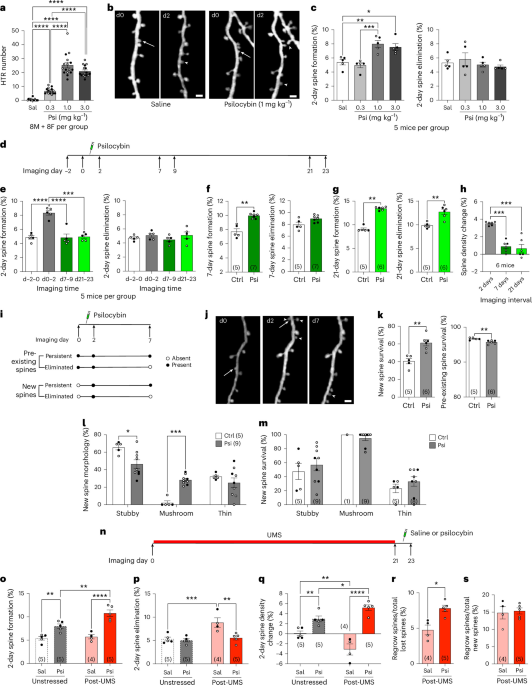
It is unclear how serotonin 2A receptors (5-HT2ARs) in cortical layer 5 pyramidal neurons differentially contribute to psilocybin-induced hallucinations versus neuroplasticity. Here we show that psilocybin promotes synapse formation and maturation while accelerating the elimination of pre-existing synapses. Cell type-specific manipulation further demonstrated that 5-HT2AR signaling in cortical layer 5 pyramidal neurons is necessary and sufficient for psilocybin-induced synaptic remodeling but dispensable for the head-twitch response, a rodent proxy of hallucination.
This is a preview of subscription content, access via your institution Access Nature and 54 other Nature Portfolio journals Get Nature+, our best-value online-access subscription Receive 12 print issues and online access Prices may be subject to local taxes which are calculated during checkout Source data are provided with this paper. The custom-written data analysis codes are available via GitHub at https://github.com/ZuoLabUCSC/branch-specific-spine-formation. Rev. 68, 264–355 https://doi.org/10.1124/pr.115.011478 (2016).
Article CAS PubMed PubMed Central Google Scholar Halberstadt, A. Effect of hallucinogens on unconditioned behavior. Neurosci. 36, 159–199 https://doi.org/10.1007/7854_2016_466 (2018).
The effects of psychedelics on neuronal physiology. Physiol. 86, 27–47 https://doi.org/10.1146/annurev-physiol-042022-020923 (2024). Uyar, A., Forbrich, L., Lueken, U. & Evens, R.
Landscape analysis of pre-registered clinical trials involving classical psychedelics. Psychopharmacol. 40, 720–731 https://doi.org/10.1177/02698811251371690 (2025). Article PubMed PubMed Central Google Scholar Liao, C., Dua, A.
N., Wojtasiewicz, C., Liston, C. & Kwan, A. Structural neural plasticity evoked by rapid-acting antidepressant interventions. Neurosci. 26, 101–114 https://doi.org/10.1038/s41583-024-00876-0 (2025).
Extract — continue reading at the source.