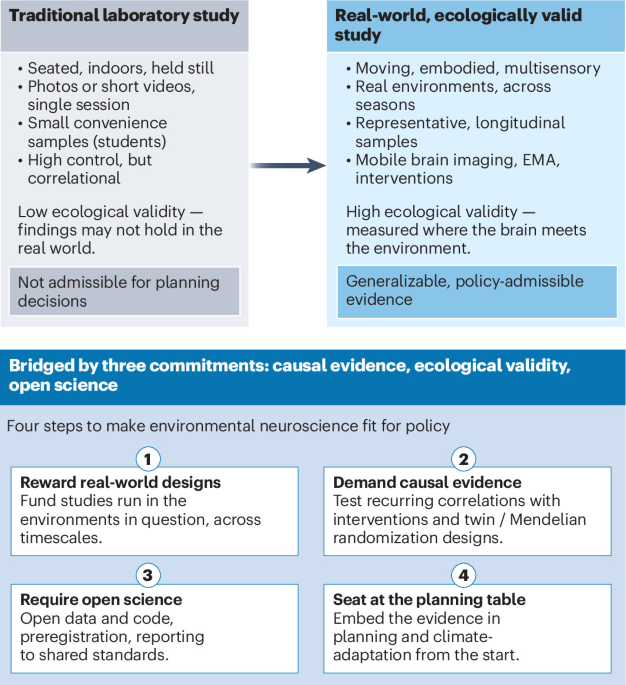
The built and increasingly hot environment shapes mental health at population scale. To help build healthier cities, those working in the emerging field of environmental neuroscience must commit to three things: causal evidence, ecological validity and open science. This is a preview of subscription content, access via your institution Receive 12 digital issues and online access to articles Prices may be subject to local taxes which are calculated during checkout Robert Koch-Institut. https://doi.org/10.25646/14340 (2026).
Med. 31, 4065–4074 (2025). Health 7, e580–e589 (2023). World Urbanization Prospects 2025: Summary of Results (2025).
Med. 51, 1099–1110 (2021). Neurosci. 22, 1389–1393 (2019). Psychol. 74, 1039–1052 (2019).
Meyer-Lindenberg, A. & Weinberger, D. Neurosci. 7, 818–827 (2006). Lancet 379, 1292–1293 (2012).
Article PubMed PubMed Central Google Scholar Larsen, S. P., Gwin, J. & Makeig, S. Psychophysiol. 91, 22–29 (2014).
Re-Engineering Philosophy for Limited Beings: Piecewise Approximations to Reality (Harvard Univ. Psychol. 96, 102308 (2024). These authors contributed equally: Andreas Meyer-Lindenberg, Simone Kühn.
Extract — continue reading at the source.