There may be no more a macabrely misogynistic sentence in English literature than Edgar Allan Poe’s contention that “the death… of a beautiful woman” is “unquestionably the most poetical topic in the world.” (His perhaps ironic observation prompted Sylvia Plath to write, over a hundred years later, “The woman is perfected / Her dead / Body wears the smile of accomplishment.”) The sentence comes from Poe’s 1846 essay “The Philosophy of Composition,” and if this work were only known for its literary fetishization of what Elisabeth Bronfen calls “an aesthetically pleasing corpse”—marking deep anxieties about both “female sexuality and decay”—then it would indeed still be of interest to feminists and academics, though not perhaps to the average reader. But Poe has much more to say that does not involve a romance with dead women. The essay delivers on its title’s promise.
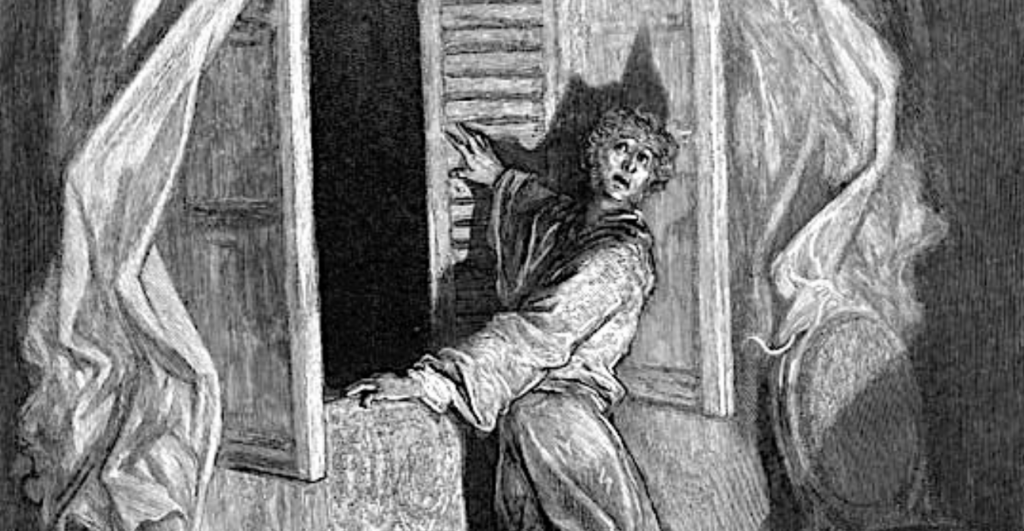
It is here that we find Poe’s famous theory of what good literature is and does, achieving what he calls “unity of effect.” This literary “totality” results from a collection of essential elements that the author deems indispensable in “constructing a story,” whether in poetry or prose, that produces a “vivid effect.” To illustrate what he means, Poe walks us through an analysis of his own work, “The Raven.” We are to take for granted as readers that “The Raven” achieves its desired effect. Poe has no misgivings about that. Against commonplace ideas that writers “compose by a species of fine frenzy—an ecstatic intuition,” Poe has not “the least difficulty in recalling to mind the progressive steps of any of my compositions”—steps he considers almost “mathematical.” Nor does he consider it a “breach of decorum” to pull aside the curtain and reveal his tricks.
Below, in condensed form, we have listed the major points of Poe’s essay, covering the elements he considers most necessary to “effective” literary composition. Poe contends that “if any literary work is too long to be read at one sitting, we must be content to dispense with the immensely important effect derivable from unity of impression.” Force the reader to take a break, and “the affairs of the world interfere” and break the spell. This “limit of a single sitting” admits of exceptions, of course.
It must—or the novel would be disqualified as literature. Poe cites Robinson Crusoe as one example of a work of art “demanding of no unity.” But the single sitting rule applies to all poems, and for this reason, he writes, Milton’s Paradise Lost fails to achieve a sustained effect. The author must decide in advance “the choice of impression” he or she wishes to leave on the reader.
Poe assumes here a tremendous amount about the ability of authors to manipulate readers’ emotions. He even has the audacity to claim that the design of the “The Raven” rendered the work “universally appreciable.” It may be so, but perhaps it does not universally inspire an appreciation of Beauty that “excites the sensitive soul to tears”—Poe’s desired effect for the poem. Poe claims the highest ground for his work, though it is debatable whether he was entirely serious.
As “Beauty is the sole legitimate province of the poem” in general, and “The Raven” in particular, “Melancholy is thus the most legitimate of all poetical tones.” Whatever tone one chooses, however, the technique Poe employs, and recommends, likely applies. It is that of the “refrain”—a repeated “key-note” in word, phrase, or image that sustains the mood. In “The Raven,” the word “Nevermore” performs this function, a word Poe chose for its phonetic as much as for its conceptual qualities.
Extract — continue reading at the source.