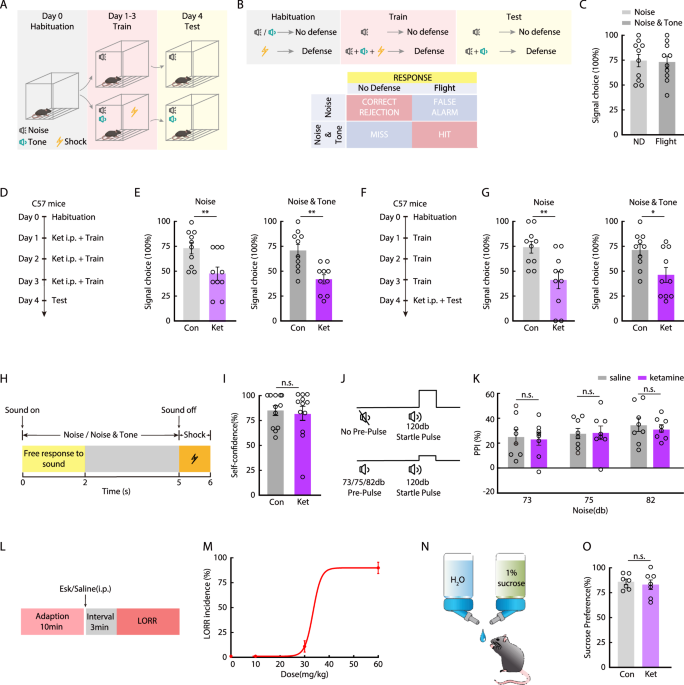
Hallucinations are a core feature of several psychiatric disorders, but the circuit mechanisms that separate perception from behavioral output remain poorly defined. Here, we combined an auditory discrimination task with AI-based pose analysis to quantify S-ketamine-induced false auditory threat responses and behavioral disorganization in mice. Control assays, including sucrose preference, loss of righting reflex, and prepulse inhibition, indicated that these effects were not explained by anhedonia, anesthesia, or basic auditory deficits.
Using in vivo fiber photometry, single-cell miniscope calcium imaging, and pathway-specific chemogenetic and optogenetic manipulations, we identified dissociable circuit contributions within convergent striatal pathways. The basolateral amygdala to caudal striatum pathway (BLA→TS) supported salience-weighted perceptual decisions and, when aberrantly recruited by S-ketamine, promoted auditory false alarms. In contrast, the medial prefrontal cortex to caudal striatum pathway (mPFC→TS) primarily shaped behavioral expression and, when dysregulated, generated disorganized action patterns.
At the network level, S-ketamine shifted TS activity from a sparse, high-contrast state to a high-frequency, low-amplitude, diffusely coupled state, consistent with reduced integrative precision. Auditory cortex to TS inputs were not broadly suppressed, supporting pathway specificity. Bidirectional chemogenetic manipulation of BLA→TS and mPFC→TS pathways in drug-naive mice further supported the TS as an integrative node linking perceptual evaluation to behavioral output.
Dexmedetomidine co-administration restored pathway-level temporal dynamics and reorganized TS network coupling without simply suppressing activity. Together, these findings define a circuit framework for NMDAR-antagonist-induced hallucination-like states and provide a mechanistic rationale for dexmedetomidine-mediated mitigation of S-ketamine-associated perceptual and behavioral disruption. This is a preview of subscription content, access via your institution Receive 12 print issues and online access Prices may be subject to local taxes which are calculated during checkout All data supporting the findings of this study are available in the main text, supplementary materials, and the Source Data file.
Analysis code is available at [GitHub URL https://github.com/liuliuzhizhi/DIVE]. Reasonable requests for additional materials can be addressed to the corresponding author (X.L.). Mourgues-Codern C, Benrimoh D, Gandhi J, Farina EA, Vin R, Zamorano T, et al.
Emergence and dynamics of delusions and hallucinations across stages in early psychosis. Biol Psychiatry. 2025;98:679–88. Article PubMed PubMed Central Google Scholar Fernyhough C, de Boer J, Davis PE, Schneider M, Moriguchi Y, Alderson-Day B, et al.
Extract — continue reading at the source.


