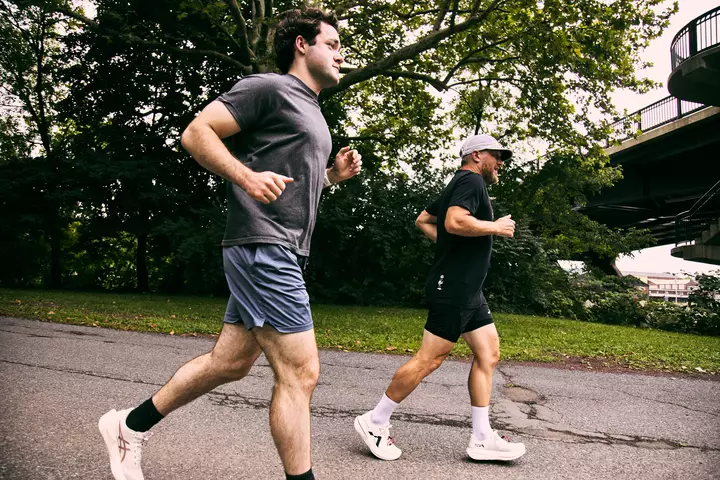
When I signed up for my first marathon, I knew I would face one of my biggest weaknesses: threshold workouts. I’ve always been stronger in short distance races than long, but the marathon requires getting better at holding goal pace for much longer. And as any run coach would tell you, the best way to get better at that is to do more threshold workouts.
Some experienced runners understand the importance of threshold work so well they train with double thresholds (as in two in one day!), where you split one threshold workout into morning and evening sessions, allowing you to cover a bit more ground than you would in a single session alone. Many elite run coaches and pros swear by this method, including Marius Bakken, MD, a two-time Olympic distance runner and author of The Norwegian Method Applied, which explains the strategy, as well as four-time world record holder and two-time Olympic gold medalist Jakob Ingebrigtsen. Eager to see if this particular workout method fit into my a marathon build, I tapped a pro run coach who uses it in his marathoners’ schedules so I could try it for myself.
Here’s everything to know about executing double threshold workouts, and how it can get you to your next PR. In the simplest terms, threshold pace represents the maximum speed you can sustain before lactate accumulates in the blood at a rate you can’t clear fast enough and therefore fatigue. Another useful way to think of it is the fastest pace you can hold for about an hour straight, says Jon Green, head coach of Verde Track Club and former coach to Olympic distance runners Emily Infeld and Molly Seidel.
A threshold workout is any workout that includes bouts of threshold-paced efforts, with recovery in between. These speed sessions are designed to help you run faster for longer distances. A double threshold, in its truest form, is doing two threshold workouts in one day—one in the morning and one in the evening—with the intention to maximize volume, Green explains.
Double thresholds aren’t exclusively for elite runners, but whether they’re right for you and your training depends on your fitness level and running goals. Green has seen recreational runners incorporate double thresholds into their programming to get better at threshold pace, which can help improve the aerobic capacity necessary for running longer distances, particularly at a faster speed. Threshold pace raises your ceiling so you can run at a harder aerobic effort for longer before reaching an anaerobic effort, Green says.
Longer-distance races are overwhelmingly aerobic, so improving aerobic capacity allows runners to perform better, become more comfortable at race pace, and improve overall fitness. Because of this, double thresholds are best suited for those training for longer distances, like the 10K, half marathon, or full marathon. By splitting threshold work into two sessions (morning and evening), runners can accumulate more threshold volume in a single day than they could in one session—without excessive fatigue, Green explains.
Extract — continue reading at the source.