Gratitude is a fundamental social emotion for interpersonal interaction. Previous studies have identified appraisals of benefactor’s behavior and intention, and recipient’s benefit as crucial determinants of interpersonal gratitude. However, they largely ignored the continuous appraisal nature of gratitude and left unclear how integrative evaluation of different determinants unfold when a beneficial outcome is not guaranteed.
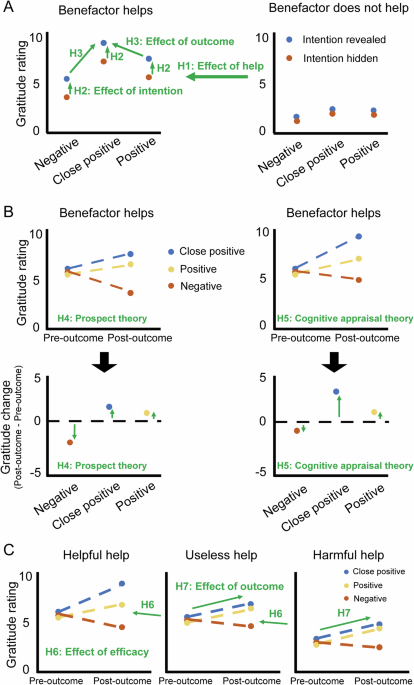
Here we developed an interpersonal interactive paradigm and asked participants to report their feelings at different appraisal stages of the interaction. In Experiment 1 (N = 52 participants), we demonstrated that this paradigm could effectively capture interactions between appraisals of benefactors’ behavior and intention, and appraisals of recipients’ benefit. In Experiment 2 (Experiment 2a: N = 61; Experiment 2b: N = 150; Experiment 2c: N = 72), we examined the continuous appraisal processes by showing that benefactors’ help could substantially elicit recipients’ gratitude without the evaluation of benefit, and that the outcome of help decision further interacts with the initial decision to affect recipients’ gratitude towards benefactors.
In Experiment 3 (Experiment 3a: N = 62; Experiment 3b: N = 150), we generalized the continuous appraisal approach to a more sophisticated context and examined the impact of help efficacy (helpful vs. useless vs. harmful help) on gratitude. Our findings suggest that benefactors’ decision to help can elicit gratitude without outcome evaluation, the outcome that is decisively determined by benefactors’ help has a strong effect on gratitude, and the outcome that is not directly affected by the help could nevertheless promote or dampen gratitude. Together, the current study advances our understandings of integrative evaluation of different determinants underlying interpersonal gratitude via a continuous appraisal framework.
Gratitude is widely considered a positive emotional response when individuals receive benefactor’s help that is valuable to them and costly to the benefactors1,2. Known as the “parent of all the virtues”3,4, gratitude plays a crucial role not only in influencing social and moral behaviors5,6,7, such as reciprocity8,9,10, generosity11, and altruistic punishment12, but also in facilitating the development of human society13,14. According to an influential theory15, experiencing gratitude depends on evaluating three crucial determinants: the benefactor’s intention, the cost to the benefactors, and the value of the benefit to recipients.
Empirical studies have reinforced the roles of these determinants in generating gratitude. First, recipients show stronger gratitude and more reciprocal behaviors if benefactors incur higher costs in deciding to help16,17,18. Second, while greater benefits can promote gratitude19,20, this effect is context-dependent and may not always generate gratitude21,22,23.
Third, the role of benefactors’ intentions in gratitude is more nuanced: people may experience increased gratitude as benefactors’ costs and their own benefits increase, even when the benefactor’s intention is not explicitly revealed10,24,25. In this sense, evaluation of determinants other than benefactors’ intention is already sufficient to elicit gratitude8, and benefactors’ intention may function as a booster to enhance gratitude10,24. It should be noted that previous research has largely treated gratitude as a static response–examining evaluative processes only after the outcome is known and assuming that both benefactor behavior/intention and tangible benefits jointly shape gratitude21,26.
Extract — continue reading at the source.


