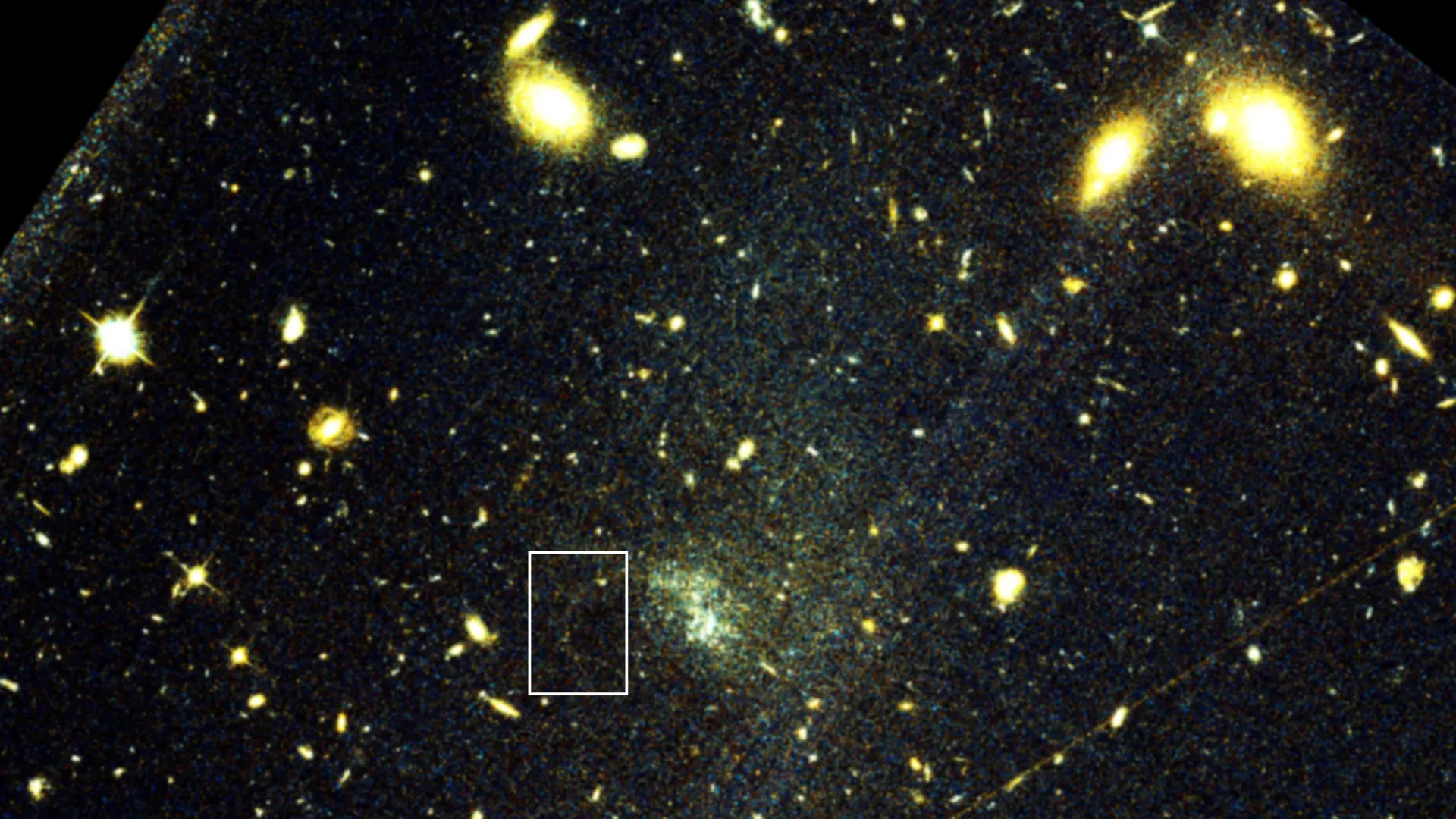
For billions of years, an ancient cluster of stars has been gradually coming apart, shedding stars that now form a faint, narrow ribbon across space. That delicate structure is offering astronomers a new way to investigate one of the universe's biggest mysteries. An international research team, including an astrophysicist from Northwestern University, has identified the first stellar stream of this type ever observed outside the Milky Way.
Astronomers have long predicted that such streams should exist around other galaxies, but their extreme faintness has made them difficult to detect. The newly discovered stream also offers scientists an unusual tool for studying dark matter, which remains one of the major unanswered questions in astrophysics. By analyzing the stream's shape, researchers reconstructed the gravitational field of its host galaxy and used that information to determine how unseen dark matter influenced the stars' paths.
The findings could eventually help scientists investigate how dark matter is distributed across many different galaxies and throughout the universe. The study was published Aug. 12 in the journal Nature. "The stars in a stellar stream all travel along nearly the same orbit, and that orbit is shaped by the galaxy's gravity," said Northwestern's Tjitske Starkenburg, who coauthored the study.
"By modeling that gravity, we can estimate the galaxy's total mass. We already know roughly how much of that mass comes from visible matter like stars, so the rest must be dark matter." Starkenburg, an expert in extragalactic astronomy, is a research assistant professor at Northwestern's Center for Interdisciplinary Exploration and Research in Astrophysics. The study was co-led by Julie Kiel Holm of the University of Copenhagen and Sarah Pearson of the Technical University of Denmark.
First Stellar Stream Found Beyond the Milky Way Globular clusters are densely packed groups of stars held together by gravity. As one of these clusters travels around its host galaxy, the galaxy's gravitational pull can slowly strip stars away from it. Those stars do not simply scatter in every direction.
Instead, they tend to continue along nearly the same orbital path, creating long, thin stellar streams that retain information about the gravitational forces they have experienced. Astronomers have identified dozens of streams produced by globular clusters inside the Milky Way. Until now, however, no comparable stream had been detected in another galaxy.
Extract — continue reading at the source.


