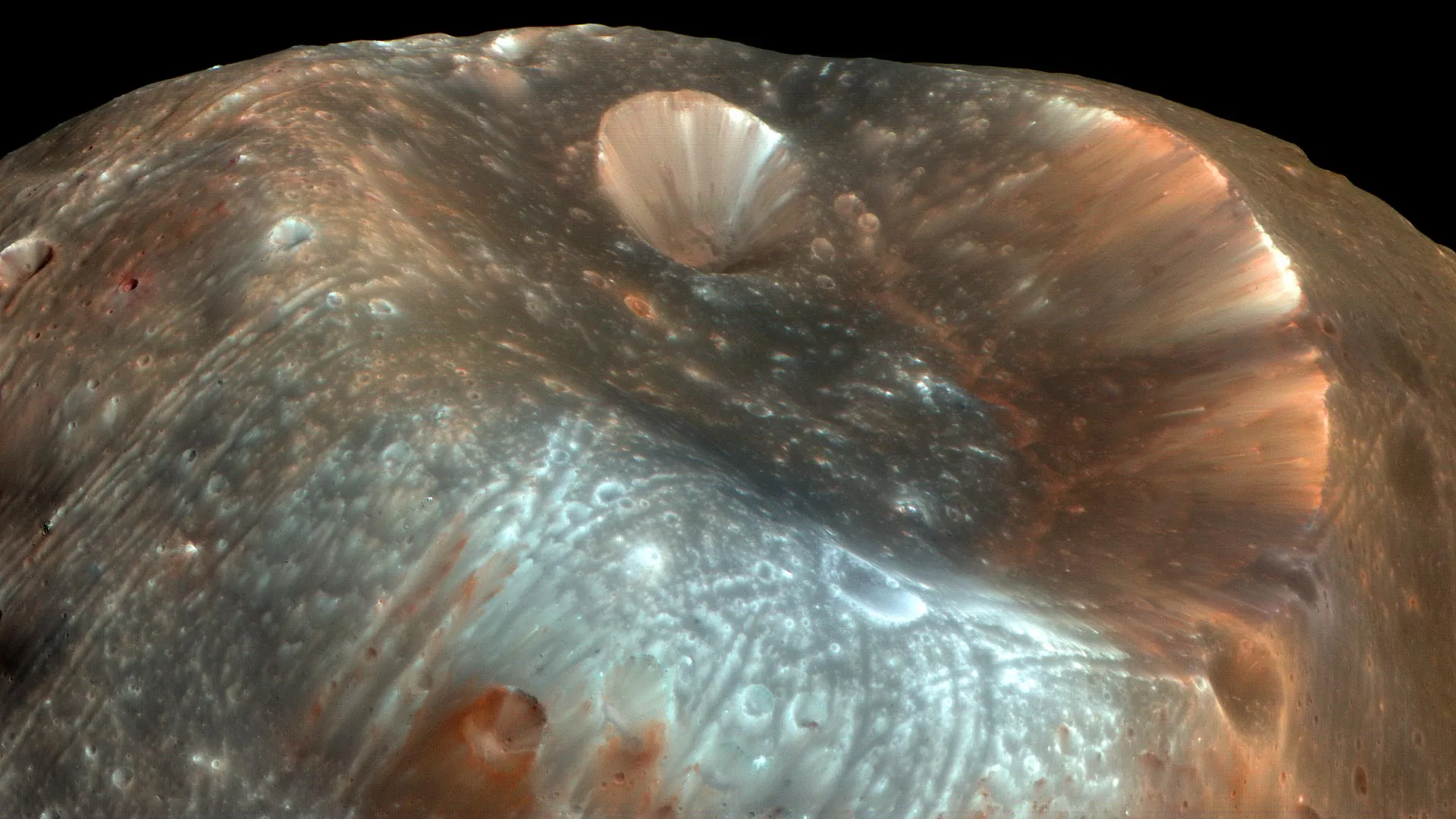
Mars' innermost moon, Phobos, has puzzled planetary scientists for decades. One of the biggest unanswered questions is where it came from. Some researchers think Phobos is an asteroid that was captured by Mars, while others argue that it formed from debris thrown into orbit after a massive object slammed into the planet.
Solving that mystery may depend on something scientists still know surprisingly little about: what Phobos looks like on the inside. Researchers are now trying to narrow down the possibilities by studying subtle characteristics of the moon, including its gravity and motion. At the recent European Geosciences Union general assembly in Vienna, scientists presented work modeling these geophysical measurements around one of Phobos' most dramatic features, Stickney Crater.
The enormous Stickney Crater is central to the debate over Phobos' history. If Phobos formed from debris created by a giant impact on Mars, the collision that produced the 9 km (5.6 mile) diameter crater may have occurred roughly 4.2 billion years ago. If Phobos was instead captured as an asteroid, the Stickney impact could have happened much later, around 2.6 billion years ago.
Current estimates suggest that Phobos has a porous interior that may contain water ice, according to Benjamin Haser and co-author Thomas Andert in a 2026 paper published in The Monthly Notices of the Royal Astronomical Society (MNRAS). One promising way to investigate those possibilities is to map Phobos' gravity in greater detail. The researchers are particularly interested in whether the Stickney impact created a concentrated region of denser material beneath the crater.
The Stickney event is one of the most important episodes in Phobos' history, and learning more about it could help scientists determine where the moon came from, Haser, a doctoral student in planetary science at Germany's Universität der Bundeswehr München, told me in Vienna. Phobos is small and strangely shaped, but Haser says it should not be viewed as simply a 'rock in orbit.' The moon has a mean diameter of only 22.2 km (13.8 miles) and races around Mars once every 7 hours and 39 minutes. Scientists have developed two main explanations for its origin.
Under one scenario, a giant object struck Mars and blasted material into orbit. That debris eventually formed a disc around the planet and later produced Mars' two moons, Phobos and Deimos, Haser and Andert write in their MNRAS paper. The competing idea is that the moons began as asteroids and were later captured by Mars' gravity.
Extract — continue reading at the source.


