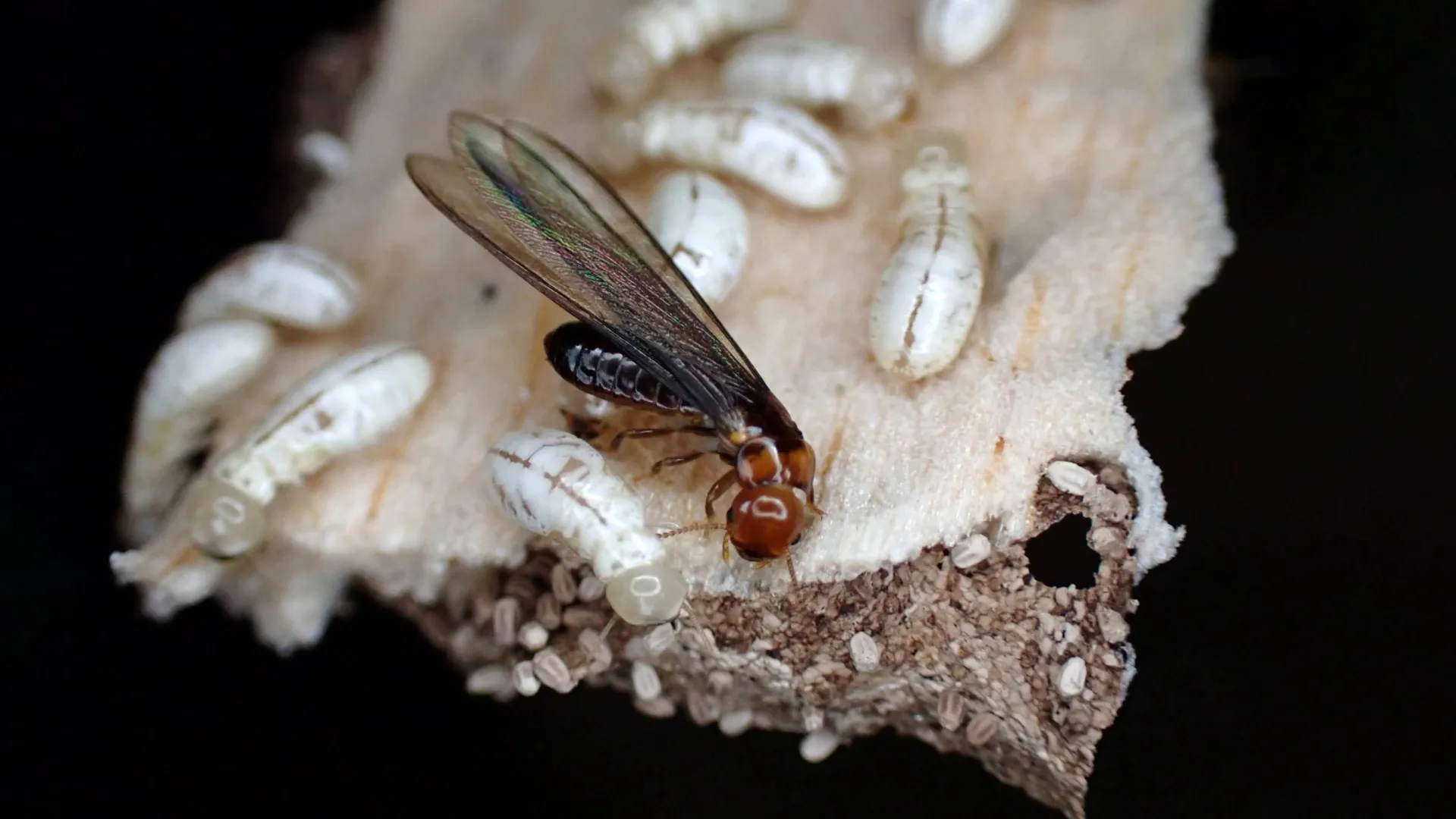
Drywood termites are remarkably good at disappearing into the very material they destroy. Instead of building obvious nests, they can spend nearly their entire lives hidden inside beams, framing, furniture, and other dry wood, slowly carving out galleries as a colony grows. That hidden existence makes them difficult to find and difficult to eliminate.
But researchers at the University of California, Riverside identified a biological weakness that termites cannot hide from: they have to molt. A study published in 2025 in the Journal of Economic Entomology showed that bistrifluron, an insect growth regulator that interferes with the formation of a new exoskeleton, can kill western drywood termites with remarkable efficiency. In controlled laboratory experiments, the chemical produced 95.7 percent mortality when termites had a choice between treated and untreated wood, and about 99 percent mortality when they were continuously exposed to treated wood.
"This chemical is more environmentally friendly than ones traditionally used for drywood termite infestations," said Nicholas Poulos, corresponding author of the paper and a doctoral student in UCR's Department of Entomology. "It's specific to insects and can't harm humans." That selectivity comes from the biology the treatment targets. Humans and other mammals have internal skeletons, but insects rely on a rigid outer covering called an exoskeleton.
One of its most important ingredients is chitin, a durable natural material that provides structure and strength. Chitin is common in nature. It helps form insect exoskeletons, fungal cell walls, fish scales, and structures such as the beaks of squids and octopi.
For termites, it provides protective armor while also creating sturdy attachment points for muscles. The problem for a growing termite is that this armor cannot simply stretch forever. Drywood termites molt about seven times during their lives, shedding the old exoskeleton and replacing it with a larger one.
Bistrifluron turns that unavoidable process into a vulnerability. It belongs to a group of compounds known as chitin synthesis inhibitors. Rather than acting like a conventional fast-acting poison, it disrupts the insect's ability to manufacture enough chitin for the next exoskeleton.
Extract — continue reading at the source.


