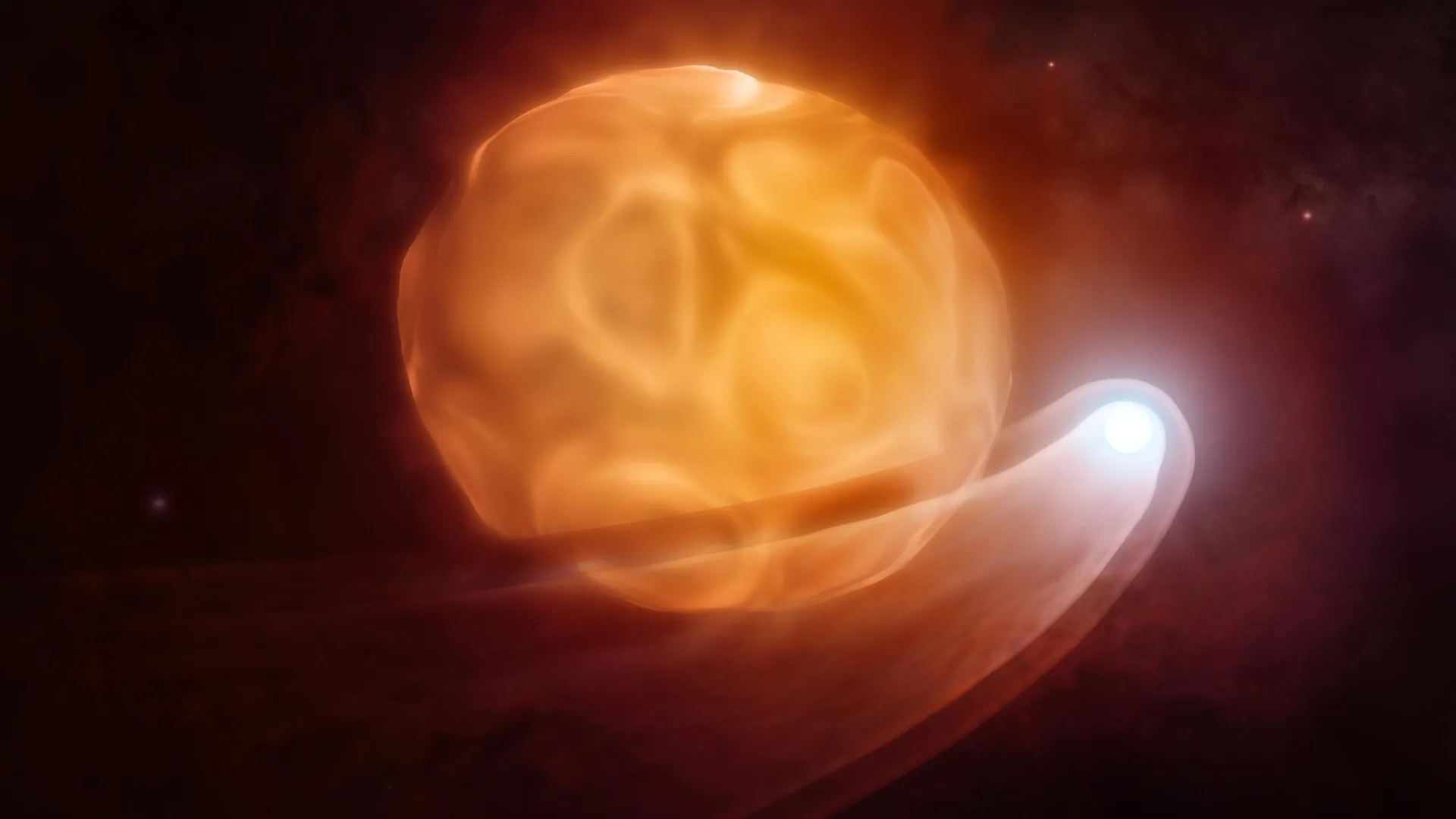
Something unusual is happening inside the enormous atmosphere of Betelgeuse, one of the most recognizable stars in the night sky. Astronomers have detected subtle changes in the star's shape that suggest something is moving through its outer layers, disturbing the surrounding gas like an unseen visitor making noise inside a house. (Metaphorically speaking.) New observations point to a likely culprit: Siwarha, a recently discovered companion star that appears to be traveling through Betelgeuse's atmosphere. Betelgeuse is a massive red supergiant located in the constellation Orion, where it forms the famous hunter's shoulder.
Although the star has fascinated astronomers for generations, it attracted worldwide attention in late 2019 and early 2020 when its brightness unexpectedly plunged to its lowest recorded level in more than 100 years. The event, known as the Great Dimming, raised questions about what was happening inside the aging star. Now, observations from the U.S.
National Science Foundation's Karl G. Jansky Very Large Array (NSF VLA) and the Atacama Large Millimeter/submillimeter Array (ALMA) reveal that Betelgeuse's vast outer atmosphere has largely returned to normal. More intriguingly, the measurements provide new evidence that a nearby companion star is physically disturbing the giant star's atmosphere.
The research was led by Dr. Matthews, Principal Research Scientist and Assistant Director at MIT Haystack Observatory, working with scientists from the Center for Astrophysics | Harvard & Smithsonian, the University of Manchester, and the European Southern Observatory. The team analyzed observations gathered between 2021 and 2026 at seven radio frequencies ranging from 22 GHz to 485 GHz.
Different radio frequencies allow astronomers to examine different depths within a star's atmosphere. By combining the observations from both telescopes, the researchers reconstructed the structure of Betelgeuse's outer layers, beginning just above its visible surface and extending outward to several times its radius. "It was the combination of the incredible data from the NSF VLA and ALMA that gave us a convincing result here," said Matthews.
"The fact that we can use these facilities to actually resolve the disks of nearby stars is amazing." Betelgeuse Recovers From Its Mysterious Great Dimming The latest measurements also help scientists understand how Betelgeuse has changed since its extraordinary fading episode. Several months before the Great Dimming (when Betelgeuse ejected a billion tons of solar material, partially blocking our view), an earlier investigation led by Matthews detected unusually low temperatures in the star's atmosphere at radio wavelengths. At the time, researchers suggested that turbulent convection deep inside Betelgeuse may have generated a shock wave that traveled outward and disrupted the surrounding gas.
Extract — continue reading at the source.