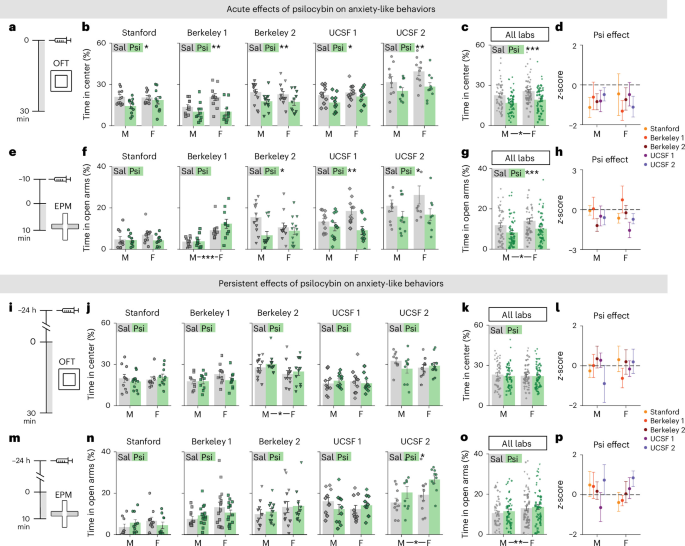
Studies reporting the effects of psychedelic drugs on mouse behavior are rapidly emerging. However, the reproducibility and reliability of these effects remain uncertain. Here we implemented a multi-institutional collaborative approach to assess which effects of psilocybin on mouse behavior are robust and replicable.
Five independent laboratories performed the same experiments to test the acute and persistent effects of psilocybin (2 mg kg−1, intraperitoneally) on various behaviors. Psilocybin acutely increased anxiety- and avoidance-related behaviors and decreased fear expression in a robust and replicable manner. Surprisingly, however, psilocybin did not have replicable effects 24 h after administration in terms of reducing anxiety- and depression-like behaviors or facilitating fear extinction learning.
Additionally, we did not observe psilocybin-induced alterations in social preference or social reward learning. Our characterization of psilocybin’s behavioral effects, using ~200 male and female mice per experiment across five laboratories, demonstrates several robust acute effects and suggests that some of psilocybin’s reported persistent effects in mice may be modest and/or inconsistent. After decades of limited research, there is now renewed interest in studying psychedelic drugs.
A single dose or a few doses of various psychedelic drugs, including psilocybin1,2,3,4,5,6,7,8, 3,4-methylenedioxymethamphetamine9,10, lysergic acid diethylamide11,12 and ibogaine13,14,15, have been reported to elicit rapid and enduring therapeutic effects for a wide range of neuropsychiatric disorders, including anxiety4,5,11,12,13,15, depression1,2,3,4,5,8,13,15, substance use disorder6,7,14 and post-traumatic stress disorder9,10,15. These preliminary clinical findings have generated great excitement in both the lay and scientific press because they suggest that psychedelic drugs may have unique therapeutic properties that could dramatically transform psychiatry. Indeed, three psychedelic drugs— 3,4-methylenedioxymethamphetamine, lysergic acid diethylamide and psilocybin—have been granted Breakthrough Therapy status by the Food and Drug Administration16,17,18,19.
Advancing our understanding of the uses for, and mechanisms of, psychedelic drugs requires that clinical and basic science findings be robust (that is, they are sufficiently large and consistent across modest variations in experimental conditions), replicable (that is, the same results can be obtained by different research groups performing the same study) and generalizable (that is, the same findings can be observed across broader populations and experimental conditions). The field has yet to establish which findings exhibit these three characteristics. For example, in terms of robustness, psilocybin, which has arguably received the greatest attention because of its promise for treating depression, failed to produce stronger antidepressant effects than the selective serotonin reuptake inhibitor escitalopram in a clinical trial20.
Some have questioned whether its effects surpass those expected from placebo21. Furthermore, inconsistent findings are evident, in terms of both psilocybin’s behavioral outcomes in the rodent forced swim test (FST)22,23,24,25,26 and its antidepressant-like mechanisms of action in mice23,27,28, suggesting a lack of generalizability across studies. With the diversity of rodent models, dosing regimens and experimental protocols used across studies, discrepancies in reported effects of psilocybin are difficult to reconcile, and replicability has not been assessed.
Extract — continue reading at the source.


