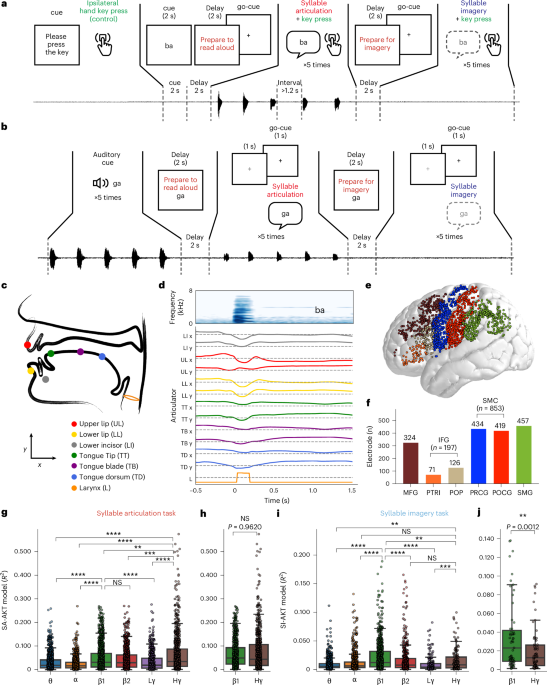
Mental imagery is a hallmark of human cognition, yet its neural mechanisms remain poorly understood. Speech imagery (the internal simulation of speech without overt articulation) has been proposed to partially share substrates with speech production, but its spatiotemporal dynamics remain controversial. Here, we leveraged high-resolution electrocorticography to investigate shared and modality-specific coding of articulatory kinematic trajectories during speech imagery and articulation.
Linear modeling revealed robust articulatory kinematic trajectories encoding in frontoparietal cortex across modalities. Supramodal populations across middle premotor, subcentral and postcentral–supramarginal regions exhibited spatiotemporal stability during integrative planning. In contrast, modality-specific populations for speech imagery and articulation were somatotopically interleaved in primary sensorimotor cortex, revealing a distinct spatiotemporal organization.
We further developed a generalized decoding framework that achieved high prediction accuracy for speech imagery (median 80.4%; chance 16.7%), comparable to speech articulation (78.3%). These findings uncover a somato-cognitive organization linking supramodal planning with modality-specific representations, informing imagery-based brain–computer interfaces. Mental imagery is a unique adaptive trait of human cognition for linking past experiences, current states and future scenarios by simulating and creating mental events1.
For example, mental imagery of speech (speech imagery, also commonly termed imagined speech) represents the internally generated, quasi-perceptual experience of speech without overt or audible articulation2,3. This phenomenon exemplifies both an instantiation of language as a vehicle for thought and a specific form of environment-disengaged action4. While overt speech production involves a well-documented sequence comprising conceptual formulation, lexical selection, phonological encoding, motor planning and the execution of articulatory movements2,3,5,6, the neural mechanisms governing speech imagery remain poorly characterized.
Addressing this gap requires clarifying the spatiotemporal relationship between speech imagery and overt articulation. Emerging neurolinguistic models, supported by findings from functional magnetic resonance imaging (fMRI), magnetoencephalography (MEG) and scalp electroencephalography (EEG), suggest that initial processes involved in motor planning for both speech imagery and articulation exhibit considerable similarities3,7,8,9. Functional localization studies reveal overlapping frontoparietal activation in regions such as the premotor cortex and supramarginal gyrus (SMG), alongside reduced or altered involvement of primary sensorimotor cortex (SMC)2,7,8,9,10,11,12.
These observations have motivated models in which speech imagery may rely on efference copies of motor commands, processed through frontoparietal forward mechanisms to support internal sensorimotor simulation and prediction of speech outcomes7,8,9; however, definitive characterization of the neural organization governing internal and external speech processes remains elusive, limited by the spatiotemporal constraints of noninvasive methods and the scarcity of intracranial recordings during speech imagery. To overcome these constraints, high-density electrocorticography (ECoG) with broad frontoparietal coverage offers an opportunity to delineate these mechanisms with enhanced spatiotemporal precision. Beyond its theoretical implications, the characterization of speech imagery has direct translational relevance.
Extract — continue reading at the source.


