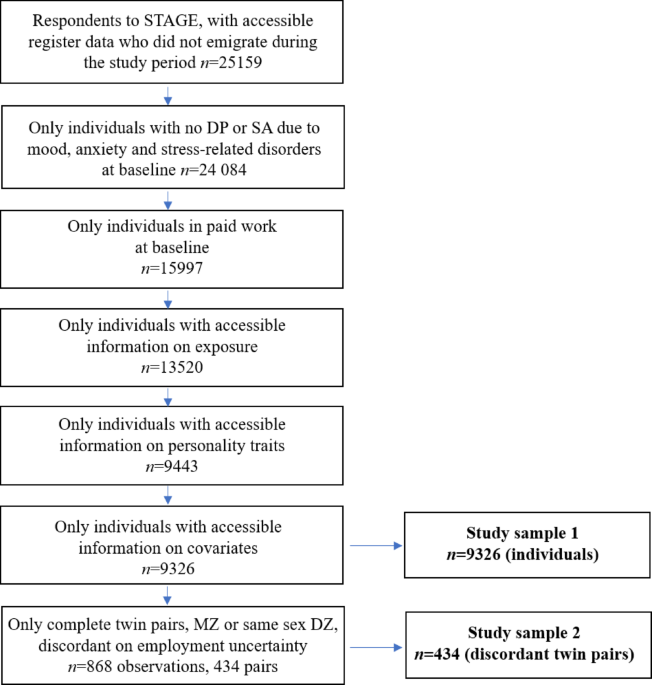
While both insecure employments and sickness absence due to mood, anxiety, and stress-related disorders are common on the labor market and pose major public health concerns, their interrelations are not well understood. This prospective twin study examined the association between employment uncertainty and sickness absence due to mental disorders, accounting for unmeasured potential confounding by genetics and shared early environment and assessing the impact of personality. The study was performed using survey and register data from 9,326 twins derived from the Swedish Twin project of Disability Pension and Sickness Absence (STODS).
Logistic regression estimated odds of medically certified sickness absence benefits following employment uncertainty. Co-twin control analyses using conditional logistic regression addressed unmeasured confounding. Interactions with extraversion and neuroticism were assessed on both multiplicative and additive scales.
Employment uncertainty was associated with sickness absence due to mood, anxiety, and stress-related disorders (adjusted OR 1.46, 95% CI 1.30–1.64) in the overall sample. In co-twin control analyses (n = 434 pairs) the association was attenuated (OR 1.09, 95% CI 0.75–1.58), suggesting that the observed association may be explained by genetics and/or shared early environment. No clear evidence of moderation by personality was observed, although findings for neuroticism were inconsistent.
We acknowledge the Swedish Twin Registry (STR) for access to data. The study utilized data from the Swedish Twin project Of Disability pension and Sickness absence (STODS) from the REWHARD infrastructure supported by the Swedish Research Council (grant no 2017 − 00624 and 2021 − 00154). The Swedish Twin Registry is managed by Karolinska Institutet and receives funding through the Swedish Research Council under the grant no 2017 − 00641.
The Study of Twin Adults: Genes and Environment (STAGE) was supported by the National Institute of Health, USA (Grants DK 066134 and CA 085739). Open access funding was provided by Stockholm University. Department of Psychology, Stockholm University, Stockholm, Sweden Maria Wijkander, Sandra Blomqvist, Petra Lindfors & Linda L Magnusson Hanson Division of Insurance Medicine, Department of Clinical Neuroscience, Karolinska Institutet, Stockholm, Sweden Maria Wijkander, Pia Svedberg, Jurgita Narusyte, Iman Alaie & Linda L Magnusson Hanson Department of Medical Sciences, Child and Adolescent Psychiatry, Uppsala University, Uppsala, Sweden Division of Clinical Psychology, Department of Psychology, Uppsala University, Uppsala, Sweden The funders were not involved in the study design, collection, or analysis of the data, interpretation of the results, writing of the paper nor in decisions about the manuscript submission.
The authors declare no competing interests. Springer Nature remains neutral with regard to jurisdictional claims in published maps and institutional affiliations. Below is the link to the electronic supplementary material.
Extract — continue reading at the source.


