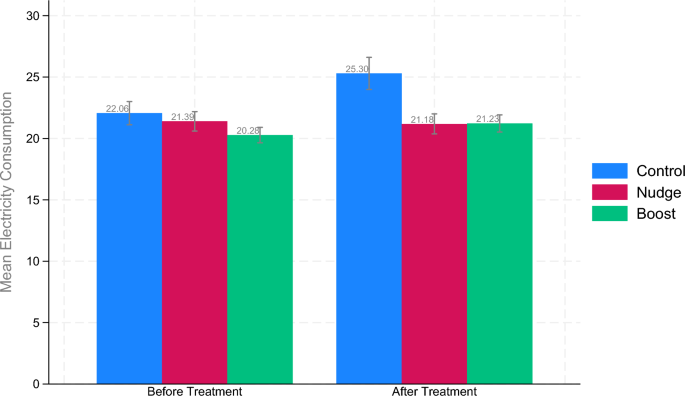
Behavioral interventions can promote household energy conservation, yet evidence on the mediators and moderators driving their effects remains limited. In a 24-week randomized field experiment with 140 student households, we contrasted two behavioral interventions: a social comparison “nudge” with a competence-enhancing “boost”. Specifically, the nudged group received weekly normative feedback on their electricity use relative to their peers, while the boosted participants accessed device-specific energy-saving tips.
Both treatments significantly reduced electricity consumption relative to control by attenuating the seasonal increase observed among untreated households, corresponding to avoided consumption of ~7 MWh. Exploratory analyses indicated that the effects were concentrated among participants with higher baseline consumption. Within this group, the Boost intervention was associated with a statistically significant reduction of 3.97 kWh per week relative to control.
The nudged participants reduced their weekly consumption by 3.12 kWh. While both interventions performed similarly over time, evidence for competence enhancement was limited: competence scores increased modestly in the boost group relative to control, but this effect became marginal after correcting for multiple testing. Further evidence indicates that intervention effects were strongest among participants with higher pre-treatment competence and environmental motivation, suggesting a moderating role of these variables.
Behavioral interventions (BIs) are used to promote sustainable outcomes such as energy conservation. Reducing energy consumption is desirable both for individual households (by reducing utility costs) as well as for society at large. While most BIs share similar benevolent goals, the strategies they employ vary substantially: Nudges1 leverage cognitive biases and subtle environmental changes to induce energy savings, while boosts2,3 promote energy savings by enhancing people,s conservation competences4.
This distinction relies on specifying the mechanisms through which boosts and nudges influence behavior. A useful way to situate it is the COM-B model, which conceptualizes behavior as a function of capability, opportunity, and motivation5. From this perspective, boosts primarily target capability: they aim to increase people,s psychological capacity to act effectively by improving knowledge, skills, and competences.
In the energy domain, a boost could improve residents, conservation capabilities by providing device-specific, actionable energy saving strategies6. Nudges, by contrast, typically alter the choice environment or make particular cues more salient, thereby shaping motivation and opportunity without necessarily expanding the person,s underlying capability. A mechanistic distinction also clarifies why boosts often require active cooperation from the target individual7.
Extract — continue reading at the source.


