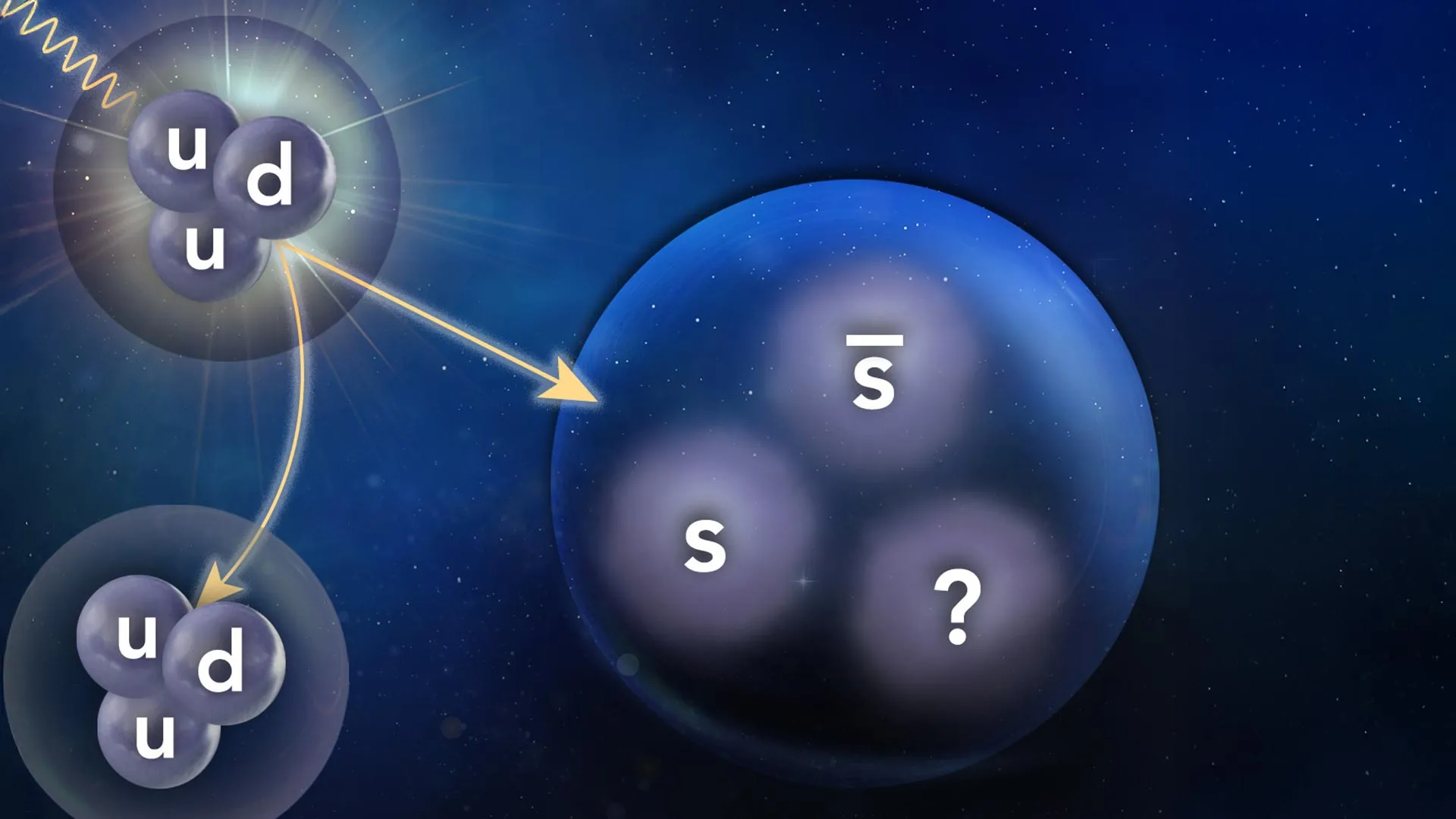
Physicists have spent decades organizing the growing collection of subatomic particles, yet some discoveries continue to resist easy classification. Department of Energy's Thomas Jefferson National Accelerator Facility have now identified evidence for two unexpected structures that may help clarify part of this increasingly complicated particle landscape. The signals could shed light on a puzzling group of objects known as XYZ states.
These states do not fit neatly into the conventional picture of particles built from quarks, the fundamental building blocks of matter. For the first time, Jefferson Lab researchers detected two such signals created when a beam of high-energy photons interacted with a proton target. The findings come from the Gluonic Excitations (GlueX) Collaboration in Experimental Hall D at Jefferson Lab and were recently published in Physical Review Letters.
The results could help scientists better understand how one of nature's fundamental forces contributes to the formation of matter. "We went searching for a confirmed XYZ candidate with a photon beam but instead found two other structures," said Malte Albrecht, a staff scientist at Jefferson Lab. "It's new information." Beginning in the 1950s, high-energy collision experiments started revealing large numbers of subatomic particles collectively known as hadrons.
Hadrons are composite particles containing two or more quarks held together by the strong nuclear force. Familiar examples include protons and neutrons, which each contain three quarks (though they had already been identified decades earlier). Among the newly discovered hadrons were short-lived particles called mesons.
These typically consist of a quark paired with its antimatter counterpart, the antiquark. In 1964, physicists introduced the quark model to organize these bound states. The earliest version contained three quark "flavors": up, down and strange.
Up and down quarks, for example, are the ingredients that form protons and neutrons. Up, down and strange are also the three lightest types of quarks. Particle physics changed dramatically again in 1974 with the discovery of the heavier charm quark.
Extract — continue reading at the source.


