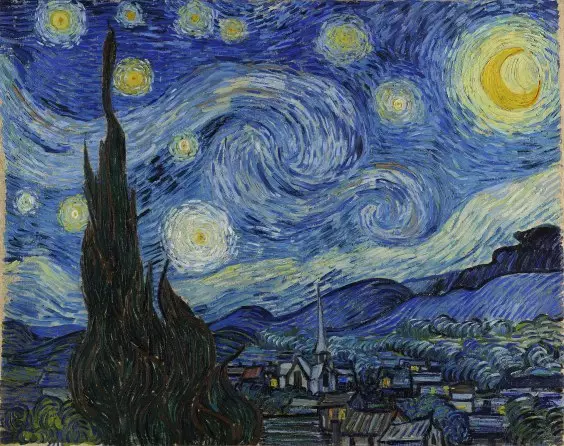
On a clear summer night in 1889, Vincent van Gogh gazed through his asylum window at the bright pre-dawn sky above Saint-Rémy-de-Provence, France. Something about the scene moved the 36-year-old, who was recovering from several mental health crises. In one letter from around early June, he wrote to his brother, Theo: “This morning I saw the countryside from my window a long time before sunrise, with nothing but the morning star, which looked very big.” In mid-June, he wrote to his brother that he had completed “a new study of a starry sky.” For years, art historians have used these letters and other documentary clues to date the painting of one van Gogh’s masterpieces, The Starry Night, to June 1889.
But a team of astronomers from South Korea now claims that van Gogh created the painting during another starry night, about a month later. In a new study published this week in the journal Scientific Reports, the researchers argue that they have pinpointed the exact night sky that inspired van Gogh: July 22, 1889. Something always changes.
I believe Vincent noticed those changes and put them into the painting,” lead author Elijah Jeong-hyun Kim, the CEO of a Seoul telescope maker and an astronomy doctoral candidate at Kyung Hee University, tells Marcia Dunn of the (AP) in an email. I will bet on this date.” The theory is founded on the idea that van Gogh closely based his painting on the actual sky, rather than painting stars he imagined. With this in mind, the researchers conducted a series of forensic astronomy experiments to match the celestial alignment depicted in The Starry Night with what van Gogh likely saw from Saint-Rémy during the summer of 1889.
Using astronomy software, the researchers recreated every night sky during June and July 1889. The astronomers then compared the three-dimensional geometry of the painting’s most prominent celestial features—stars, the crescent moon and Venus—in relation to each other, while eliminating variables such as size and color, which the artist may have embellished. They found that the Hyades—a v-shaped cluster of five stars within the Taurus constellation—were the best fit for the stars appearing in van Gogh’s painting.
That finding disputes conclusions reached in previous studies which had suggested that Aries was The Starry Night’s dominant constellation. At dawn, when van Gogh was known to paint, “the stars of Aries are relatively faint, hardly enough to inspire a painter,” Kim tells Scientific American’s Emma Gometz. July 22, 1889, was the date that matched all the conditions, according to the study.
The moon was a crescent shape and sat above Venus in the sky. The Hyades would have fit within the frame. The night was clear enough for van Gogh to see the stars, according to a weather analysis.
Extract — continue reading at the source.