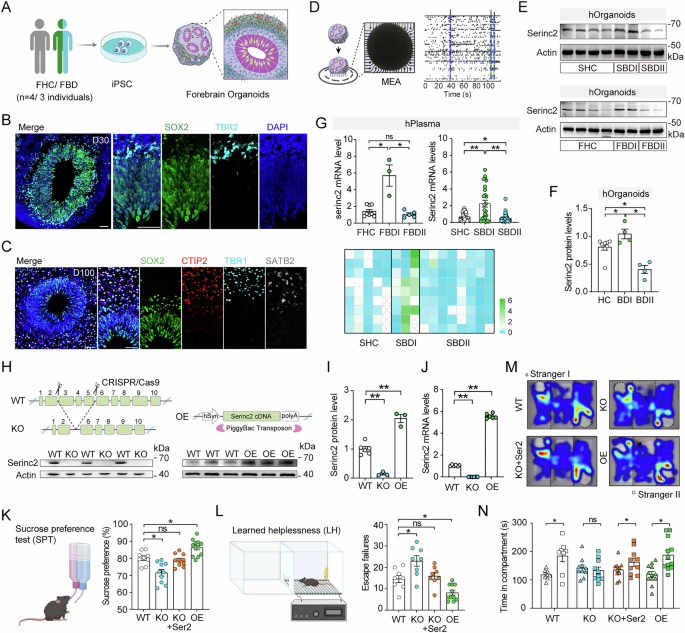
Bipolar disorder (BD) shows strong heritability and distinct symptomatic subtypes. However, the molecular basis underlying subtype-specific features remains poorly understood. Here, we identified Serinc2, a BD susceptibility gene encoding a L-serine transporter that regulates membrane lipid synthesis, as a regulator of mood-related behavioral phenotypes.
Using patient plasma samples, BD iPSC-derived forebrain organoids, and Serinc2 knockout/overexpression mouse models, we found that Serinc2 expression was increased in bipolar I (BDI) but decreased in bipolar II (BDII); bi-directional manipulation of Serinc2 induced opposite changes in synaptic transmission and depression-related behaviors, accomplied by alterations in PS/SM-dependent redistribution of NMDAR subunits in postsynaptic membranes. Mechanistically, we found that thioredoxin (Txn) bound to the Serinc2 regulatory region and negatively regulate its transcription, and that differential chromatin accessibility of Txn contributed to subtype-associated expression patterns. Together, our results demonstrated a Txn–Serinc2–lipid signaling axis that linked membrane lipid composition to synaptic function and mood-related behaviors, and indicated a potential molecular framework contributing to subtype-specific features of BD.
This is a preview of subscription content, access via your institution Receive 12 print issues and online access Prices may be subject to local taxes which are calculated during checkout All data that support the findings of this study are available in the main text or supplementary information of the paper. RNA-seq data and ATAC-seq data have been deposited in the NCBI Gene Expression Omnibus under accession numbers GSE336697 and GSE336922, respectively. Lipidomics data have been deposited in MetaboLights under accession number MTBLS14954.
The mass spectrometry proteomics data have been deposited to the ProteomeXchange Consortium (https://proteomecentral.proteomexchange.org) via the iProX partner repository with the dataset identifier PXD080653. Further information and requests for resources and reagents should be directed to and will be fulfilled by corresponding authors. Gene-environment interactions in severe mental illness.
Front Psychiatry. 2014;5:48. Kieseppä T, Partonen T, Haukka J, Kaprio J, Lönnqvist J. High concordance of bipolar I disorder in a nationwide sample of twins.
Am J Psychiatry. 2004;161:1814–21. McGuffin P, Rijsdijk F, Andrew M, Sham P, Katz R, Cardno A. The heritability of bipolar affective disorder and the genetic relationship to unipolar depression.
Extract — continue reading at the source.