Genetic variations in the ABCC2 gene have been proposed to influence resistance to antiseizure medications, but published findings to date are inconsistent. We aimed to systematically review and meta-analyze the association of three ABCC2 polymorphisms, rs2273697 (c.1249G >A, p.Val417Ile), rs717620 (c.-24C>T, 5′ UTR), and rs3740066 (c.3972C>T, p.Lys1324=), with antiseizure medication (ASM) resistance and to evaluate the statistical power, effect sizes, and required sample sizes. Searches covered PubMed, Scopus, the Cochrane Library, and NCBI dbSNP publication records (from inception to May 2026).
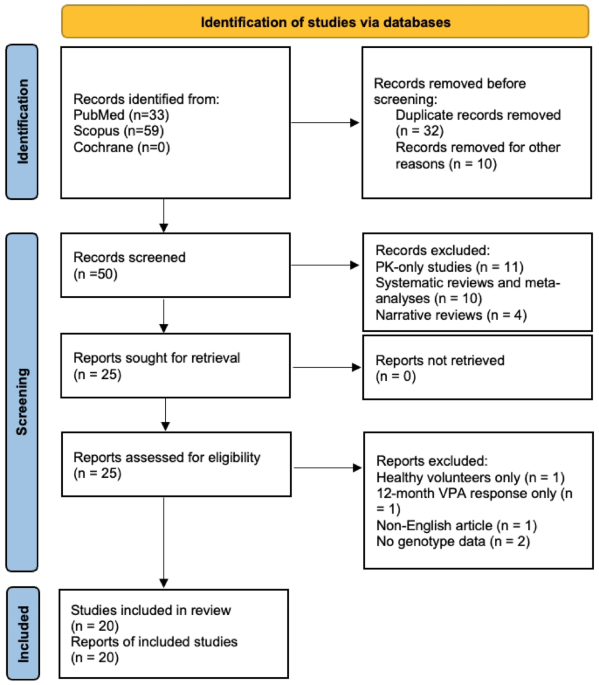
The review followed PRISMA guidelines, and study quality was assessed using the Newcastle–Ottawa Scale (NOS). Statistical power and effect sizes (Cohen’s w) were estimated using G*Power 3.1, and random-effects meta-analyses were performed for all polymorphisms. Twenty studies (2627 ASM-resistant and 2639 ASM-responsive patients) met the inclusion criteria.
Rs717620 was significantly associated with ASM resistance under the allelic (OR 1.25, 95% CI 1.06–1.48), dominant (OR = 1.25, 95% CI 1.01–1.54), recessive (OR 1.63, 95% CI 1.13–2.37), and homozygous (OR 1.79, 95% CI 1.17–2.74) genetic models, with low-to-moderate heterogeneity and no evidence of small-study bias. The pooled estimates for rs2273697 and rs3740066 were null across the genetic models. Most included studies were underpowered.
Estimated median sample-size increases of 348%, 322%, and 289% were required for rs2273697, rs3740066, and rs717620 studies, respectively, to achieve 80% statistical power. The rs717620 (c.-24C>T, 5′ UTR) polymorphism showed the most consistent association with antiseizure medication resistance across genetic models. Given the limited statistical power of many existing studies, future research should focus on large consortium-based cohorts to improve statistical power and incorporate haplotype analysis.
According to the International League Against Epilepsy, “drug-resistant epilepsy is defined as the failure of adequate trials of two tolerated, appropriately chosen and used antiepileptic drug schedules (whether as monotherapies or in combination) to achieve sustained seizure freedom”1. A recent systematic review and meta-analysis showed that the overall pooled cumulative incidence of drug-resistant epilepsy (DRE) is 19.6% (95% CI: 14.4–25.4)2. The introduction of novel antiseizure drugs has not substantially reduced the overall incidence of DRE3.
Although multiple mechanisms have been proposed to explain drug resistance, the mechanisms by which seizures become resistant to treatment remain unclear. One proposed mechanism involves altered drug transport across the blood–brain barrier mediated by efflux transporters. The main efflux transporters analyzed include P-glycoprotein (ABCB1 gene), multidrug resistance-associated proteins (MRPs, ABCC family), and breast cancer resistance protein (ABCG2 gene)4.
Extract — continue reading at the source.


