Napoleon Bonaparte once supposedly declared Constantinople to be “the empire of the world.” From its founding as the capital of the Byzantine Empire under Roman emperor Constantine in the 4th century C.E. until the fall of the Ottoman Empire in the 1920s, the city today known as Istanbul was indeed the epicenter of two successive, world-defining civilizations. The city’s role in that sweeping, nearly 1,600-year saga is the focus of “Constantinople to Istanbul: One City, Two Empires,” a major exhibition at London’s Victoria and Albert Museum. Opening November 7, the exhibition unites more than 200 rare objects from Byzantine and Ottoman times.
The journey begins in 330 C.E., when Constantine selected the former Greek settlement of Byzantium as an eastern counterpart to Rome. Among the early relics is a bronze serpent head from the famous Serpent Column, which Constantine relocated directly from Delphi to furnish the city’s central hippodrome. At the hippodrome, Romans “thronged in their thousands to cheer on the chariot racers and wolf whistle dancing girls as they performed lascivious burlesques,” Peter Sarris, a historian at the University of Cambridge, writes in the London Times.
One such dancer, Sarris points out, was Theodora, the future wife of the Byzantine emperor Justinian. In the sixth century, Justinian commissioned the Hagia Sophia, a spellbindingly large cathedral that was built in less than six years and served as the religious core of the East Roman world. When envoys sent by Vladimir the Great, the pagan Grand Prince of Kyiv, visited the Hagia Sophia in the 10th century, they were so mesmerized by its grandeur that they “knew not whether [they] were in heaven or earth.” The exhibition assembles a “rich range of liturgical objects” from the cathedral and beyond, per the statement.
One rare object on view is the Lincoln Typikon, an illuminated, 14th-century manuscript from a Constantinople nunnery, on loan from Lincoln College, Oxford, for the first time in six decades, the Art Newspaper’s Gareth Harris reports. The typikon’s delicate illustrations of the convent of the Virgin of Sure Hope offer a vivid window into monastic life just a century before the capital’s fall. After the Ottomans conquered Constantinople in 1453, the city’s new rulers both honored and transformed their new domain.
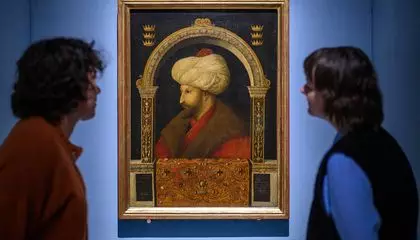
Sultan Mehmet II converted Hagia Sophia into a mosque while intentionally retaining its original name, turning the ancient Christian monument into the aesthetic blueprint for grand Islamic architecture across the capital. The transition to Ottoman splendor is heralded by Gentile Bellini’s 1480 portrait of Mehmet II, reflecting a court hungry for Renaissance artistry. The later imperial rooms showcase opulent displays of secular and military authority.
Among them are a 30-foot-long, 17th-century processional scroll illustrating the sultan’s elaborate palace retinue, a silk kaftan woven with shimmering gold thread and a pair of gold pistols presented by the Ottoman court to Britain’s King George III, per the Telegraph’s Alastair Sooke. The exhibition concludes away from royal palaces, diving into the lively social spaces of the 19th-century city of Istanbul through depictions of buzzing coffee houses, literary salons and public bathhouses. Soumya Sagar is a former medical researcher who conducted research in neurosurgery at some of the top hospitals in the U.S.
Extract — continue reading at the source.