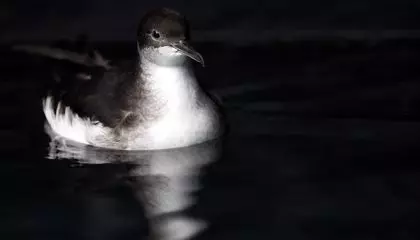
Traveling rapidly across multiple time zones often throws our internal clocks out of whack. But new research suggests jet lag is not unique to humans—some birds may also experience it. A new study published October 29 in the journal Science finds that the internal clocks of Manx shearwaters can get out of sync with local time because the birds fly so fast.
These jet lag-like time shifts confuse their sun-based compasses, and cause them to become slightly disoriented and fly a little off course. Black on top and white on bottom, Manx shearwaters are medium-sized seabirds that spend most of their lives flapping over the open ocean. But in late winter and early spring, roughly 80 percent of the world’s population returns to the steep, grassy islands off the western coasts of the United Kingdom to breed.
Here, they reunite with their lifelong mates and nest in underground burrows, with females laying one egg that eventually hatches into a fluffy chick. Adult birds head out in search of food, bringing back tasty morsels of herring, sardine and sprat to feed their growing chicks. The birds that nest near the U.K. regularly travel more than 600 miles west from their breeding islands to forage in the food-rich waters of the Irish Sea and the northeast Atlantic Ocean.
Once they’ve filled their bellies, they make the return eastward journey, navigating back to their colonies with “remarkable efficiency,” the study’s co-authors write in the paper. Scientists think Manx shearwaters successfully find their way back home by using the sun as a compass, determining which direction to fly based on its position in the sky. But “to use the sun as a compass, you have to know what time of day it is,” lead author Patrick Lewin, an ecologist at the University of Oxford, tells NPR’s Geoff Brumfiel, since the sun’s overhead position changes throughout the day as the Earth rotates on its axis.
Manx shearwaters rely on their internal clocks to help make sense of the sun’s movements and stay on track. Scientists wondered whether the birds’ speedy east-bound homing journeys might be messing with their internal clocks—similar to jet lag in humans. They theorized that, as the birds zip across the ocean, their internal clocks do not keep pace with the changes to local time, which could affect their sun compasses and, in turn, their overall navigational accuracy.
To test this idea, researchers analyzed 20 years’ worth of GPS tracking data from 1,045 wild breeding Manx shearwaters. The birds made 3,688 trips between their breeding grounds and foraging grounds, but the scientists were most interested in their homing flights, so they isolated 1,837 of their eastward, home-bound journeys. The researchers predicted that, as the birds headed east, jet lag would cause them to fly slightly off course in a clockwise direction.
Extract — continue reading at the source.