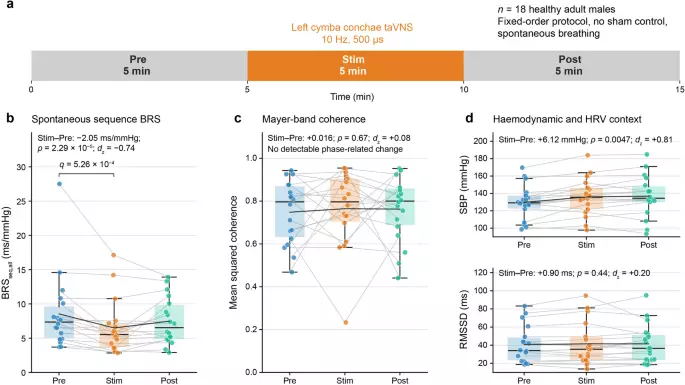
Transcutaneous auricular vagus nerve stimulation (taVNS) delivers afferent inputs, but cardiovascular responses are heterogeneous and autonomic outcomes are not interchangeable. In this exploratory, non-randomised, open-label study, 18 healthy men completed fixed-order five-minute Pre, left-cymba Stim, and Post phases without sham. Spontaneous sequence baroreflex sensitivity (BRSseq, all; designated centrally post hoc) was lower during Stim than Pre (8.54 ± 5.57 versus 6.49 ± 3.89 ms/mmHg; paired mean difference − 2.05, BCa 95% CI − 3.81 to − 1.10; Wilcoxon p = 2.29 × 10− 5; Cohen’s dz = − 0.74), with negative differences in 17/18 participants.
Mayer-band coherence and representative heart rate variability indices showed no detectable Stim–Pre differences. Systolic blood pressure was higher during Stim. Recovery of BRS was not established.
No adverse events were reported after the sessions. Sequence BRS estimates blood pressure–R–R interval gain, whereas heart rate variability and coherence quantify different properties. This pattern supports prospective evaluation of sequence BRS as a session-level physiological response measure.
The design does not establish stimulation-specific engagement, direct vagal inhibition, clinical utility, or a monitoring threshold. Sham-controlled replication is required. Trial registration: Japan Registry of Clinical Trials (jRCT), jRCT1032230440.
Registered on 9 November 2023. Heart rate variability (HRV), spontaneous baroreflex sensitivity (BRS), and heart rate–blood pressure coherence describe different properties. HRV quantifies the variation in cardiac timing without requiring a blood pressure input5.
Sequence BRS estimates the local slope in ms/mmHg, relating qualifying systolic blood pressure (SBP) ramps to delayed R–R interval (RRI) changes, and is therefore an estimate of spontaneous cardiac baroreflex gain6,7,8,9. Mayer-band coherence quantifies the consistency of the linear frequency-domain relationship between RRI and SBP near 0.1 Hz; it is bounded by 0 and 1 and does not quantify the response amplitude in ms/mmHg10,11,12,13. Consequently, a difference in one measure need not be accompanied by a difference in others.
Extract — continue reading at the source.