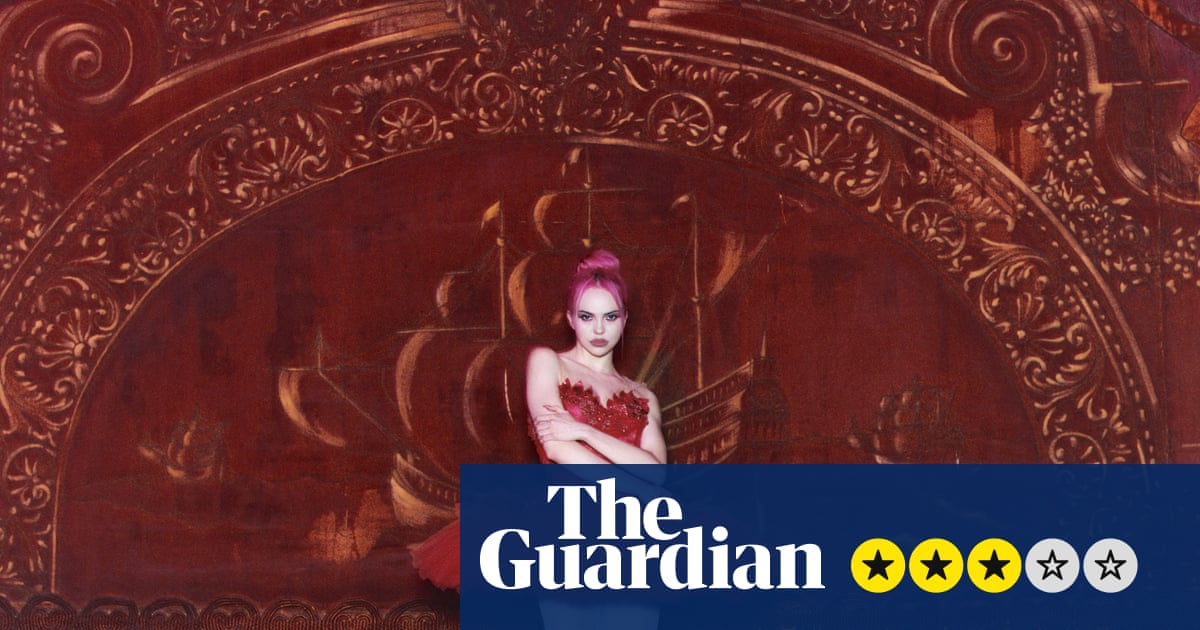
There’s something very striking about hearing a pop star in 2026, their voice larded with Auto-Tune, opening a song with the line “I can’t really sing”. We live in an era where fans seem more aware than ever of the nefarious music business machinations that lurk within the star-making process, one where you’re never far away from online outrage decrying some artist or other as an industry plant. Nevertheless, admitting that the ubiquitous audio processing software is sometimes deployed for a helping hand, not a futuristic aesthetic, feels strangely jarring.
On one hand, well of course it is. On the other, actually announcing that without it, you might be honking like a despondent goose, in the first line of a song, still amounts to a dramatic breaking of the fourth wall. That said, it’s very much on brand for Adéla Jergová, who started her career as a contestant on a TV talent show – she failed to make the cut for crumbling “global girl group” Katseye, as documented on Netflix’s Pop Star Academy – before established names alighted on her as a more left-field solo proposition: Grimes co-produced her early single Machine Girl.
New artists are well advised to have a USP, something that helps them cut through the mass of peers vying for public attention on streaming services. The 22-year-old Slovakian has chosen to differentiate herself from the serried ranks of post-Brat female pop stars by spiking her songs about hedonism and messy sexual encounters (“no bed frame, we can do it on the carpet … you eat real good for a starving artist”) with a kind of meta commentary on what it is to be a female pop star. Her debut EP, 2025’s The Provocateur, came in a sleeve that featured Jergová urinating in the street and boasted a selection of songs that depicted the cynicism of the music business and Jergová’s willingness to indulge it in her pursuit of fame.
There’s plenty more where that came from on Prima. Songs about smoking weed then having it off in a car (Marijuana) coexist with stuff like KGB – “you want a pop star with a big bra for them big hits”; songs that flippantly compare a budding romance to a pair of Christian Louboutin heels (Red Bottoms) with Therapy, home to the aforementioned line about Auto-Tune. The Monkees decried their career as “a manufactured image with no philosophies” on the soundtrack of the 1968 film Head; boyband ‘NSync depicted themselves as puppets on the sleeve of 2000’s No Strings Attached.
Although perhaps Jergová’s most pertinent spiritual forebear, given how often she drops her name in the lyrics, is mid-80s Madonna, who was happy to wear a belt-buckle that read BOY TOY if it aided her stated ambition to “rule the world”. If it’s an old trick, it still feels impressively bracing and frank, its effect amplified by the fact that it’s set to sharply written melodies and music that frequently evokes the 00s, a decade that apparently seems like a hedonistic pre-social media nirvana to those too young to remember it first-hand. Nicole Kidman revolves around the kind of sped-up old soul sample that automatically evokes Kanye West’s productions circa The College Dropout and Late Registration; the rattling tabla-driven rhythm of Boys has a distinct flavour of Timbaland’s productions for Missy Elliott; KGB is co-produced by Harrison Smith, better known as the Dare, the sometime Charli xcx collaborator praised and reviled in equal measure for his role in the indie sleaze revival.
Prima was apparently made in a hurry so that Jergová would have enough material to warrant a support slot with Demi Lovato. It definitely feels like a debut album. There are moments where it sinks into boilerplate pop: Hitachi is a standard-issue piano ballad about a failing relationship; Fantasize isn’t particularly interesting beyond the fact that its hook is played on a trombone and the opening line unexpectedly features the word “reciprocity”.
Extract — continue reading at the source.