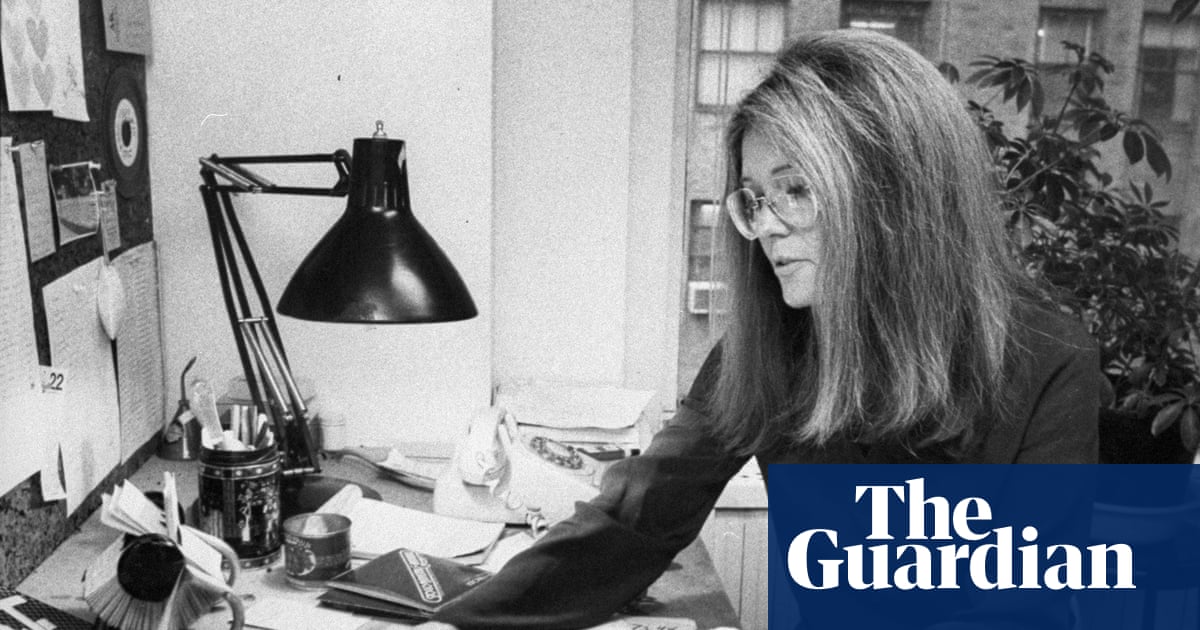
Gloria Steinem was due to speak at a women’s lunch in New York at the end of this month and at more events in October, illustrating the central theme of An Unexpected Life, her new memoir, which, when it’s published a few weeks from now, will stand as posthumous testament to the 92-year-old icon: just keep going. So it is, after her death on Wednesday, that the book’s opening pages unfold with a deep, added poignancy and when Steinem expresses gratitude for a life that has been both happier and longer “than I ever imagined”, one is struck by the greater gratitude we probably owe her. An Unexpected Life is a follow-up of sorts to My Life on the Road, the activist’s memoir of a decade ago, and as the tributes pour in, the book offers us an opportunity to go back over Steinem’s hardscrabble origins in Toledo, Ohio, and the roots of her activism.
This is where it all happened, the formation of a woman who would come to define second wave feminism by combining a tough-as-they-come stance with something that looked a lot like serenity. Reading the first half of the book, one is reminded of Steinem’s original power and the improbability and iconoclasm of her journey, in which a childhood governed by poverty and dysfunction turned into a lifelong mission to resist the narrow templates laid out for her. It’s a cracking backstory.
Steinem’s rackety father was a travelling salesman of sorts, touring the country with a dance pavilion that saw Steinem spend long stretches of her childhood with him on the road, which, she writes, conditioned her to enjoy a similarly unconventional existence in adulthood. When she was at home, the young Steinem was a carer for her increasingly mentally unwell mother, who was frequently to be found wandering the town in her nightdress, and Steinem writes movingly about what it is to grow up ashamed of your house and your family. We are all one human family, and we are responsible for one another.” Raised on instability, Steinem grew up remarkably free of the pressure weighing on most of her female peers to knuckle down into conventional marriage and motherhood, leaving her free to pursue a life as a freelance writer and, later, an activist.
After college, she went to India for two years, a defining period that informed her outlook to the very end, and on return, began her career as a campaigning journalist, which culminated in her co-founding of Ms magazine in 1971 and eventual ascent to the head of the women’s movement. These periods of her life are well documented. What I found interesting in the book were Steinem’s asides about the cost of pursuing the life she chose.
I was sure that I’d end up as a bag lady, like women I saw sleeping in subway stations. I used to handle that fear by thinking, It’s a life like any other. I’ll organize the other bag ladies.” She eventually became somewhat financially secure, largely thanks to buying part of a 19th-century brownstone on the Upper East Side of Manhattan, the beloved home in which she died this week – although a throwaway line towards the end of the book suggests she was still paying off her mortgage well into her 80s, an astonishing fact given her fame.
Steinem is the real thing, of course; she was never in it for the money. She makes a strong case that she wasn’t in it for the attention, either, although, as a talented speaker and organiser, she drew on great reserves of magnetism that over the years caused her a lot of problems with jealousy from within the movement, and condescension from without. Right until the end, Steinem was stewarding large groups of women – famous and otherwise – at “talking circles” in her house and putting herself at the centre of a conversation she had in some ways begun.
Extract — continue reading at the source.