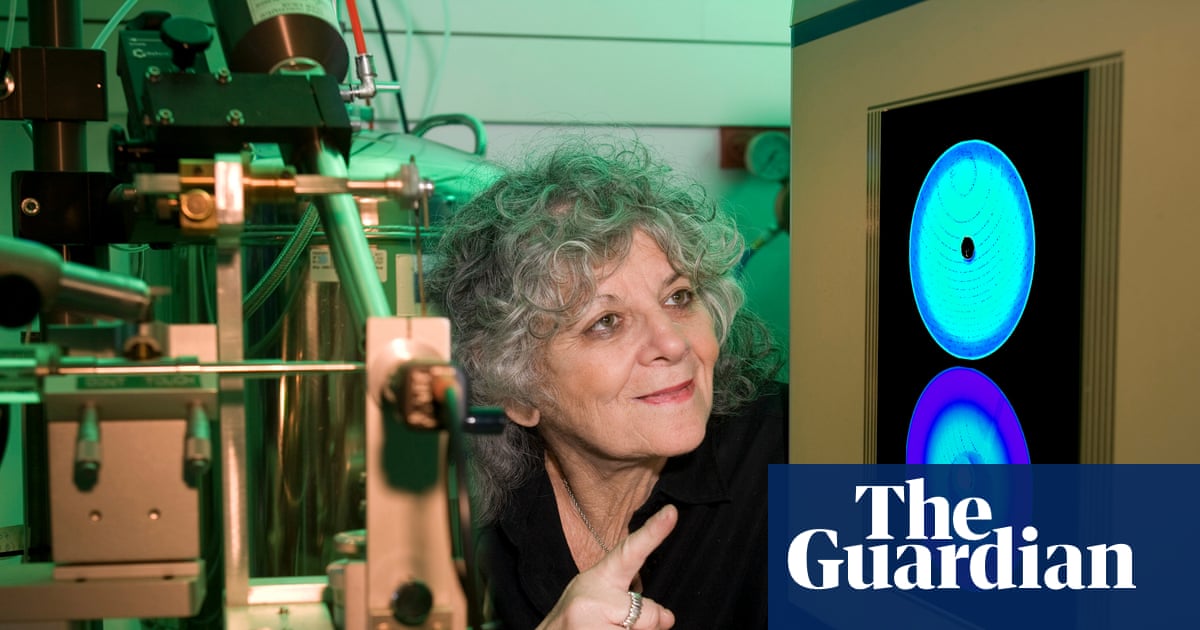
For years, the crystallographer and biochemist Ada Yonath had to contend with the disdain and sometimes derision of many of her contemporaries after she set herself the challenge of mapping the molecular structure of the ribosome. Ribosomes are found in all living cells. Effectively they are tiny factories that synthesise proteins, complex molecules that are vital for building and repairing the tissues and organs of animals and plants.
Many scientists believed hers was a fruitless endeavour because ribosomes are so small – sometimes only 20 nanometres in diameter – irregular in shape and lacking internal symmetry. James Watson, one of the Nobel prizewinning discoverers of the double-helix structure of DNA, had tried and failed. But Yonath, who has died aged 87, proved her doubters wrong, and was rewarded with the 2009 Nobel prize in chemistry, only the fourth woman to receive it, which she shared with the biologist Venkatraman Ramakrishnan and biochemist Thomas Steitz.
But when I succeeded, it created an overwhelming internal joy and those who once called me crazy or stupid became supporters.” It was in the late 1970s, while being laid up following a bicycle accident, and indulging in some “easier” reading, that Yonath, then a young scientist based at the Weizmann Institute of Science in Rehovot, Israel, chanced upon the article that would lead to her eventual breakthrough. Reading about the biology of polar bears, she learned that the bears pack their ribosomes in an orderly way in their cells prior to hibernating. So, if polar bears knew how to do it, we could too,” she reasoned.
Yonath surmised that, if she could crystallise an organism, and hence its ribosomes, she would be able to study their internal structure using X-rays and electron microscopy. However, ribosomes are fragile. Unlike other cell parts, they have no outer protective membrane and are easily damaged.
Figuring that ribosomes of organisms that live in harsh conditions were likely to be hardier and more able to survive crystallisation, she attempted to crystallise the thermophile bacteria Geobacillus stearothermophilus, found in austere environments around thermal vents and in desert sands. It took more than 25,000 attempts, but in the mid-80s, Yonath succeeded. She then froze the bacteria at –185°C, to stabilise its internal structure and to protect it from the X-rays, a technique she was an early successful pioneer of, now known as cryo bio-crystallography.
Finally, in 2001 and 2002, after almost two decades of research, Yonath’s team succeeded in mapping, in three dimensions, the bacteria’s ribosome. The significance of this discovery extended beyond pure science. Many antibiotics work by binding to sites on a bacterium’s ribosome, stopping it from reproducing.
Extract — continue reading at the source.


